Have you ever heard someone say, “She runs like the wind” or “He is as strong as an ox”? These are called similes. They are simple, powerful tools that make writing more exciting and clear.
If you’re learning creative writing, understanding the definition of similes is one of the best places to start. Similes help you paint pictures with words. Instead of telling your reader something in a boring way, you show it with comparison.
In this full guide, you’ll learn the meaning of similes, see examples of similes in real sentences, understand how to use similes in writing, and even test yourself with practice questions.
Let’s explore step by step.
What Is a Simile?
In simple terms, a simile is a figure of speech that compares two different things using the words “like” or “as.”
It helps readers understand something better by connecting it to something familiar.
Basic Formula of a Simile:
Thing + like/as + comparison
For example:
- She is as brave as a lion.
- His voice is like music.
- The baby slept like a log.
Each sentence compares two different things to create a clear image.
The meaning of similes is easy to understand. They:
- Make writing more descriptive
- Help readers imagine scenes clearly
- Add emotion and creativity
- Make simple sentences more powerful
For example:
Plain sentence:
The water was cold.
Simile sentence:
The water was as cold as ice.
Which one feels stronger? The simile gives a clearer picture.
Examples of Similes (With Explanation)
Let’s look at different types of simile sentences.
1. Similes About Speed
- He ran like the wind.
(Meaning: He ran very fast.) - The car moved as fast as lightning.
(Meaning: Extremely fast.)
2. Similes About Beauty
- She is as beautiful as a rose.
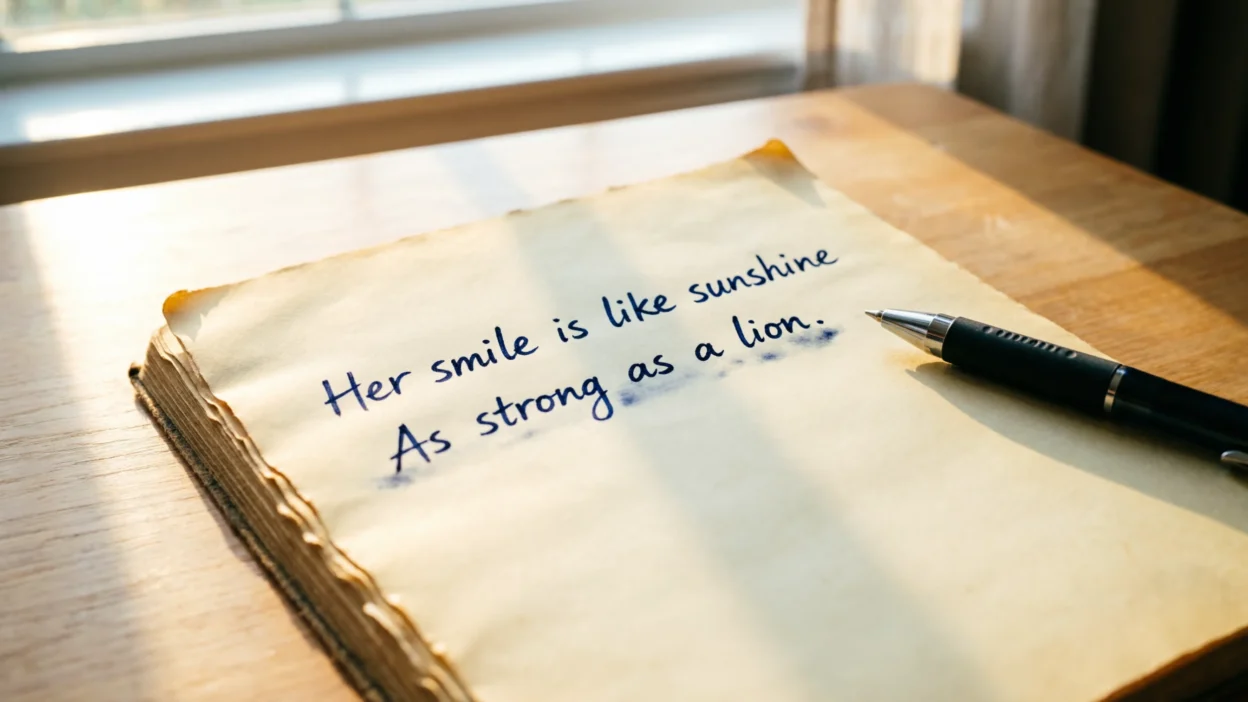
(Meaning: Very attractive and delicate.) - Her smile is like sunshine.
(Meaning: Warm and cheerful.)
3. Similes About Strength
- He is as strong as an ox.
(Meaning: Very strong.) - She stood firm like a rock.
(Meaning: Very steady and brave.)
4. Similes About Emotions
- He was as happy as a child.
(Meaning: Very joyful.) - She cried like a baby.
(Meaning: Cried loudly or deeply.)
These examples of similes show how comparisons help readers understand feelings and actions better.
Simile vs Metaphor (Quick Difference)
Many beginners get confused here.
- A simile uses like or as.
- A metaphor does not use like or as.
Example:
Simile:
Her eyes shine like stars.
Metaphor:
Her eyes are stars.
Both compare, but only the first one is a simile.
How to Use Similes in Writing
If you want to write creative writing similes, follow these easy steps:
Step 1: Think About What You Want to Describe
Is it a person? A feeling? A sound?
Step 2: Ask Yourself What It Reminds You Of
Does it remind you of nature? Animals? Objects?
Step 3: Connect Them Using Like or As
Example:
You want to describe someone who is calm.
Think: What is calm?
Answer: A quiet lake.
Simile:
She was as calm as a quiet lake.
That’s how simple it is!
Common Simile Sentence Starters
Here are helpful phrases you can use:
- As ___ as ___
- Like a ___
- Like the ___
- As ___ as the ___
For example:
- As soft as cotton
- Like a shining star
- As busy as a bee
Practical Exercise (10 Questions)
Questions
- What two words are commonly used in similes?
- Identify the simile: “The sky looked like a painting.”
- Is this a simile? “He is a lion.”
- Complete the sentence: She is as sweet as ______.
- Complete: He ran like ______.
- What does “as cold as ice” mean?
- Write a simile about happiness.
- Identify the comparison: “Her laugh was like music.”
- Which is a simile?
a) Time is money.
b) Time is like money. - Write your own simile about strength.
Answers with Explanation
- Like and as.
- “Like a painting” — compares the sky to a painting.
- No. That is a metaphor because it does not use like or as.
- Sugar (or honey).
- The wind (or lightning).
- It means very cold.
- Example: “He was as happy as a child on his birthday.”
- Her laugh is compared to music.
- b) Time is like money.
- Example: “She is as strong as a mountain.”
Why Similes Matter in Creative Writing
Similes make your writing more interesting. They:
- Add imagination
- Improve storytelling
- Help readers feel emotions
- Make descriptions clearer
When you learn how to use similes in writing, your sentences become alive. Instead of just telling facts, you create pictures in your reader’s mind.
For example:
Plain:
The night was dark.
With simile:
The night was as dark as coal.
The second one feels stronger and clearer.
Conclusion
Now you understand the full definition of similes, have seen many examples of similes, and learned how to use similes in writing step by step.
In simple terms, similes compare two different things using like or as to create clearer, more creative sentences. They turn ordinary writing into something vivid and memorable.
Here’s your next step: Try writing five simile sentences today. Start small. Compare something simple like the sky, a smile, or the wind. The more you practice, the more natural it will feel.
Creative writing becomes easier when you use similes and now you know exactly how to use them. ✍️✨

Nick Mateo is a U.S.-based content writer at Aslikee who focuses on creating clear, reliable, and user-friendly content. He is passionate about delivering information that is easy to understand and genuinely helpful for readers.
He spends significant time researching topics to ensure accuracy and relevance. Nick believes that high-quality content is built on trust, transparency, and consistency, and he applies these principles in every article he works on.
At Aslikee, Nick contributes to maintaining strong editorial standards and improving the overall quality of the platform. His goal is to support users with well-structured, value-driven content that meets their needs.