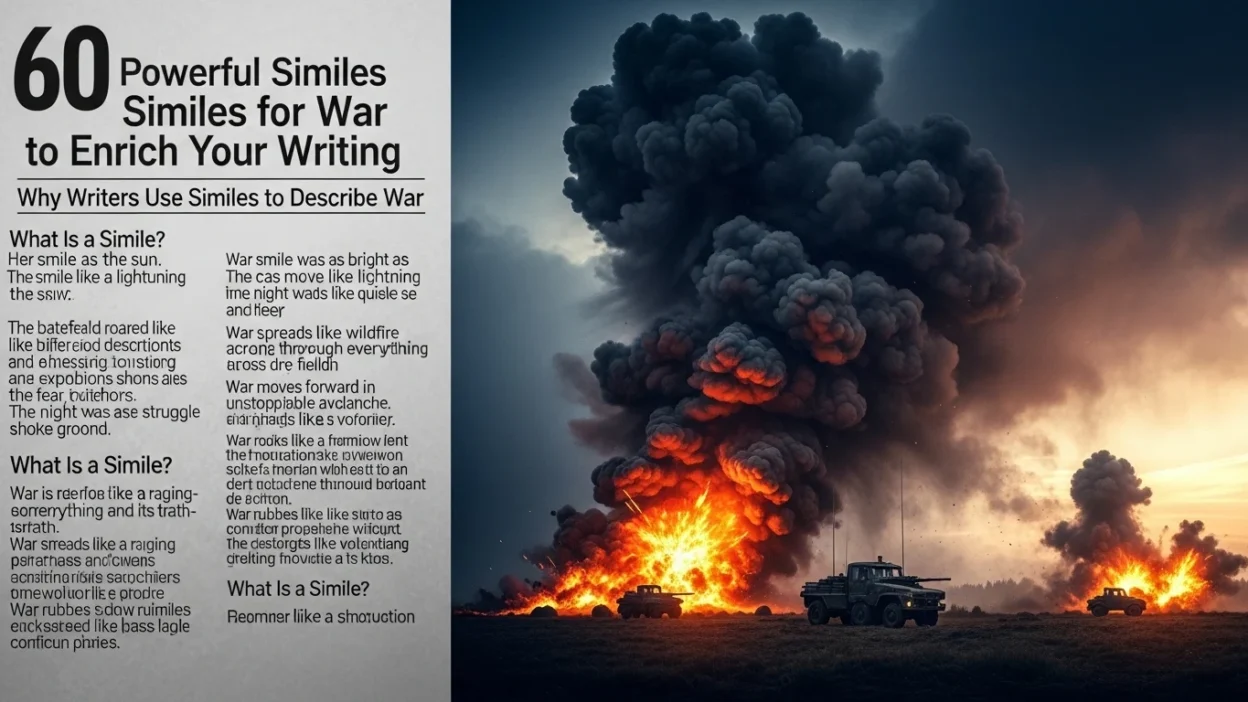
Similes are an important literary device that writers use to make their descriptions more vivid and engaging. A simile compares two different things using the words “like” or “as.” These comparisons help readers better imagine scenes, emotions, and events.
When writing about war, similes are especially useful because war is intense, chaotic, and emotional. By comparing war to storms, fire, animals, or natural disasters, writers can help readers understand the power and destruction of conflict.
In this article, you will find 60 powerful similes for war that can improve your essays, stories, poems, and creative writing.
What Is a Simile?
A simile is a figure of speech that compares two things to highlight a shared quality.
Examples of Similes
- Her smile was as bright as the sun.
- The car moved like lightning.
- The night was as quiet as a whisper.
Similes make writing more interesting because they create clear and memorable images in the reader’s mind.
Why Writers Use Similes to Describe War
War is a complicated and emotional subject. Writers use similes to make descriptions clearer and more powerful. Similes can help show:
- The noise and chaos of battle
- The destruction left behind
- The fear and sadness people feel
- The bravery and struggle of soldiers
For example:
The battlefield roared like a violent storm as explosions shook the ground.
This comparison helps readers imagine the intensity of the moment.
Similes for War That Show Power and Chaos
- War is like a raging storm, tearing through everything in its path.
- War spreads like wildfire across dry fields.
- War crashes like thunder across the mountains.
- War moves forward like an unstoppable avalanche.
- War strikes like lightning in the night sky.
- War roars like a furious lion.
- War erupts like a volcano bursting open.
- War sweeps across the land like a violent hurricane.
- War explodes like fireworks in a dark sky.
- War rumbles like thunder rolling across the horizon.
Similes for War That Show Destruction
- War destroys cities like a hammer smashing glass.
- War burns like a forest fire in summer.
- War spreads damage like cracks in broken ice.
- War tears through buildings like a tornado.
- War shatters lives like a dropped mirror.
- War crushes hope like heavy boots on dry leaves.
- War breaks nations like waves breaking cliffs.
- War collapses walls like falling dominoes.
- War leaves ruins like a storm leaving broken trees.
- War scatters people like wind scattering sand.
Emotional Similes for War
- Fear spreads like cold wind through an open door.
- Silence after battle feels like a graveyard at midnight.
- Loss in war hurts like a deep wound in the heart.
- Memories of war linger like scars on the skin.
- War sadness falls like heavy rain.
- Pain from war grows like a thorn in the heart.
- Grief after war spreads like shadows at sunset.
- War memories echo like whispers in an empty hall.
- Fear rises like smoke from burning wood.
- War leaves hearts heavy like stones in a river.
Similes for Soldiers in War
- Soldiers stood strong like mountains in a storm.
- Soldiers charged forward like arrows from a bow.
- Soldiers moved silently like shadows in the night.
- Soldiers fought bravely like lions protecting their land.
- Soldiers waited like hunters watching their prey.
- Soldiers marched together like waves rolling toward the shore.
- Soldiers held their ground like walls protecting a fortress.
- Soldiers ran like deer escaping danger.
- Soldiers advanced like thunder across the sky.
- Soldiers guarded their country like watchful wolves.
Short Similes for War
- War is like a storm.
- War is like a raging fire.
- War is like a dark shadow.
- War is like a wild beast.
- War is like thunder in the sky.
- War is like a crashing wave.
- War is like a spreading flame.
- War is like shattered glass.
- War is like a sudden lightning strike.
- War is like a roaring engine of destruction.
Creative and Unique Similes for War
- War spreads like ink spilled across a page.
- War grows like weeds in an abandoned garden.
- War moves like a shadow chasing the sun.
- War spreads fear like frost across a window.
- War consumes hope like flames devouring paper.
- War advances like a dark tide rising at night.
- War echoes like drums in a distant valley.
- War surrounds people like walls closing in.
- War crushes peace like a boot crushing a flower.
- War ends suddenly like a candle blown out by the wind.
Tips for Using Similes in Writing
1. Keep Comparisons Clear
Choose comparisons that readers can easily imagine.
2. Avoid Overusing Similes
Using too many similes can make writing confusing.
3. Match the Tone
For serious topics like war, use strong and meaningful comparisons.
4. Focus on Imagery
Good similes help readers clearly picture what is happening.
Example:
The explosions echoed like thunder across the battlefield.
Conclusion
Similes help writers describe complex topics in a vivid and engaging way. When writing about war, similes can show the chaos, destruction, fear, and bravery that come with conflict.
By comparing war to storms, fires, animals, and natural disasters, writers can create strong imagery that helps readers understand the experience more clearly. The 60 similes for war in this article can help you improve your storytelling, essays, and creative writing.

Henry James is the primary author and content creator at Aslikee. Based in the United States, he is passionate about creating informative, reliable, and easy-to-understand content for a global audience.
With a strong focus on accuracy and user value, Henry specializes in researching topics thoroughly and presenting them in a clear, practical way. His writing reflects a commitment to quality, transparency, and continuous learning, ensuring readers receive content they can trust and benefit from.
At Aslikee, Henry James plays a key role in shaping the website’s vision and maintaining high editorial standards. He believes in delivering content that is not only helpful but also engaging and accessible for users of all backgrounds.
When he’s not working on content, Henry enjoys exploring new ideas, staying up to date with digital trends, and improving the overall user experience of the platform