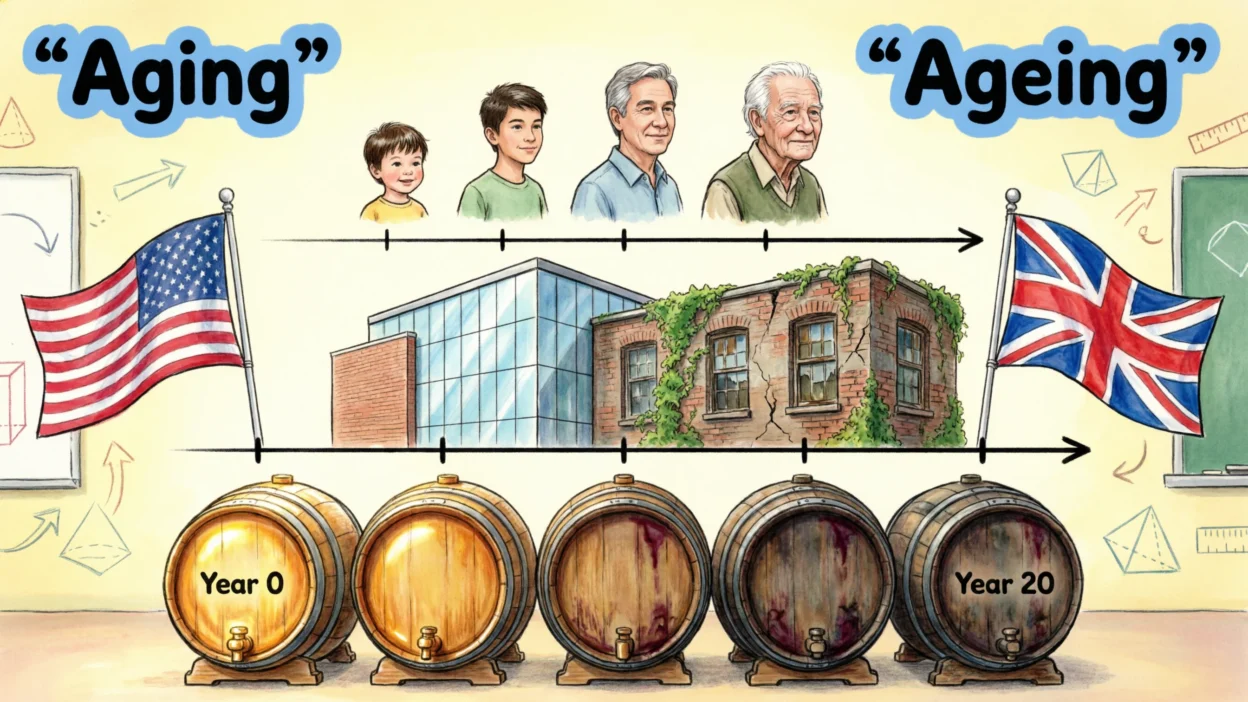
Many English learners wonder whether “aging” or “ageing” is the correct spelling. Since both forms appear in books, newspapers, and online articles, it can be confusing to know which one to use.
👉 The simple answer is:
✔️ Both “aging” and “ageing” are correct.
However:
- Aging is the preferred spelling in American English and is also widely used internationally.
- Ageing is the preferred spelling in British English.
👉 For example:
- The population is aging rapidly. 🇺🇸
- The population is ageing rapidly. 🇬🇧
Both spellings have the same meaning.
What Does “Aging” Mean?
Aging is the present participle of age.
👉 It means:
- Growing older
- Becoming mature over time
- Undergoing changes due to the passage of time
Examples:
- The population is aging.
- Fine cheese is aging in the cellar.
- He is aging gracefully.
- The building is aging and needs repairs.
What Does “Ageing” Mean?
Ageing has exactly the same meaning as aging.
👉 It is simply the British English spelling.
Examples:
- The population is ageing.
- The wine is ageing in oak barrels.
- She is ageing well.
- The equipment is ageing and may need replacement.
Aging vs Ageing (Quick Comparison)
| Word | Type of English | Meaning |
|---|---|---|
| Aging | American English | Growing older over time |
| Ageing | British English | Growing older over time |
👉 Important:
The meaning is identical. Only the spelling differs.
Sentence Examples
Using “Aging”
- The aging bridge requires maintenance.
- The population is aging quickly.
- He is aging gracefully.
Using “Ageing”
- The ageing bridge requires maintenance.
- The population is ageing quickly.
- She is ageing gracefully.
Common Mistakes
❌ Aging and ageing have different meanings.
✔️ They have the same meaning.
❌ Only one spelling is correct.
✔️ Both spellings are correct depending on regional English.
👉 Remember:
- 🇺🇸 American English → aging
- 🇬🇧 British English → ageing
Practice Time
Fill in the blanks:
- The population is ______ rapidly.
- The wine is ______ in barrels.
- He is ______ gracefully.
- The building is ______ and needs repairs.
- The country’s ______ population presents new challenges.
Answers:
- aging / ageing
- aging / ageing
- aging / ageing
- aging / ageing
- aging / ageing
Easy Memory Trick
👉 Think like this:
- American English often prefers shorter spellings:
- aging
- molding
- judgment
- British English often keeps the extra letters:
- ageing
- moulding
- judgement
This pattern can help you remember which spelling matches your audience.
Final Thought
Both aging and ageing are correct spellings of the present participle of age. The only difference is regional preference. Aging is the standard spelling in American English and is commonly used worldwide, while ageing is preferred in British English. Whether you’re discussing people, buildings, cheese, wine, or populations, both forms carry the same meaning. The key is to choose the spelling that fits your audience and use it consistently.