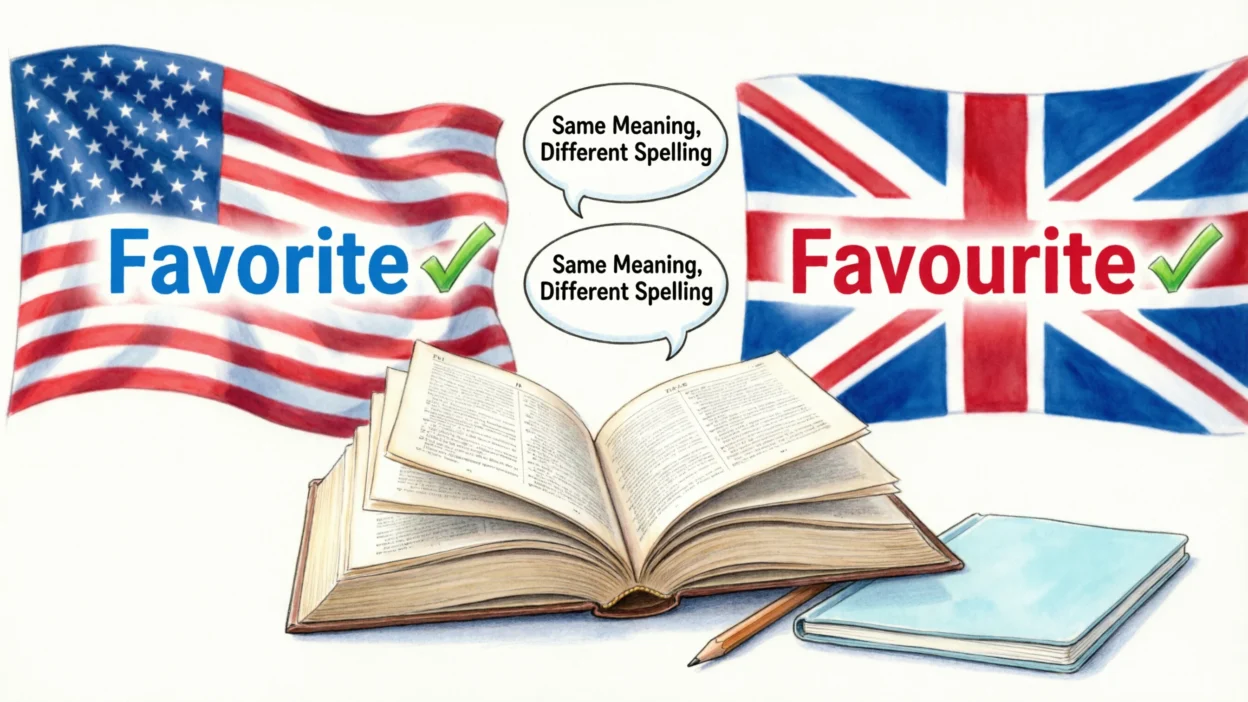
Knowing favorite or favourite becomes easy when you learn which spelling matches your English style, helping your writing stay clear and consistent. Many learners wonder which is the correct spelling, and the answer depends on the type of English you use. In the United States, American English has preferred the form favorite, while the United Kingdom follows British English, where favourite is the standard spelling. From my experience, once you understand this simple rule, it becomes easier to choose the right word every time.
The fact is that both spellings are correct, depending on the standards, style, or guide you follow. The differences between these two varieties of English are usually subtle, but they exist nonetheless, particularly around spelling. These changes have made this common language develop into slightly different forms across many countries.
You will sometimes find these spellings in books, websites, and publications. The most important thing is to stay consistent in your writing, no matter whether you use American English or British English.
What Does Favorite Mean?
The word favorite (or favourite) describes a person, place, thing, activity, or idea that someone likes more than others.
It can also be used as both a noun and an adjective.
As an adjective
- Blue is my favorite color.
- She is my favorite teacher.
As a noun
- Pizza is my favorite.
- That song has become everyone’s favorite.
Favorite or Favourite: Which One Is Correct?
The answer is simple:
✅ Favorite — Correct in American English
✅ Favourite — Correct in British English
Neither spelling is wrong. The correct choice depends on the type of English you are using.
Why Are There Two Spellings?
English developed differently in different parts of the world.
During the 1800s, American English adopted simpler spellings for many words. British English kept many traditional spellings that include the letter u.
Some common examples include:
| American English | British English |
|---|---|
| Favorite | Favourite |
| Color | Colour |
| Honor | Honour |
| Neighbor | Neighbour |
| Flavor | Flavour |
American English vs British English
Use Favorite if you write for:
- The United States
- American schools
- American businesses
- American websites
Use Favourite if you write for:
- The United Kingdom
- Australia
- New Zealand
- Ireland
- Most British publications
If you’re writing for an international audience, choose one style and stay consistent throughout your document.
When Should You Use Favorite?
Use favorite whenever you are writing in American English.
Examples
- Chocolate is my favorite dessert.
- My favorite movie is Inception.
- This is my favorite book.
- She wore her favorite dress.
- Autumn is my favorite season.
When Should You Use Favourite?
Use favourite whenever you are writing in British English.
Examples
- Football is my favourite sport.
- Tea is my favourite drink.
- London is my favourite city.
- This is my favourite café.
- Purple is her favourite colour.
Favorite vs Favourite
| Favorite | Favourite |
| American English | British English |
| No extra “u” | Includes “u” |
| Used in the USA | Used in the UK |
| Same meaning | Same meaning |
| Same pronunciation | Same pronunciation |
20 Example Sentences
- My favorite subject is science.
- Her favourite hobby is painting.
- Pizza is my favorite meal.
- Reading is his favourite pastime.
- My favorite actor won an award.
- That is my favourite song.
- Spring is our favorite season.
- This is my favourite place to relax.
- Their favorite game is football.
- My favourite holiday is Eid.
- That was my favorite moment.
- Ice cream is everyone’s favorite treat.
- This book quickly became my favourite.
- She bought her favorite flowers.
- His favourite author is well known.
- My favorite app helps me study.
- Their favourite restaurant serves great food.
- This is my favorite jacket.
- My favourite teacher inspired me.
- Family time is my favorite part of the week.
Common Mistakes
❌ My favourite color is blue. (American English)
✅ My favorite color is blue.
❌ My favorite colour is blue. (Mixed styles)
✅ My favourite colour is blue. (British English)
✅ My favorite color is blue. (American English)
Avoid mixing American and British spellings in the same document.
Easy Tips to Remember
- Favorite → America → No u
- Favourite → Britain → Has u
- Choose one style before you start writing.
- Stay consistent throughout your article.
- Use spell check if you’re unsure.
Practice Exercise
Choose the correct spelling.
- My ______ book is Harry Potter.
- Blue is my ______ color.
- She is my ______ teacher.
- Cricket is his ______ sport.
- Autumn is our ______ season.
- My ______ food is biryani.
- Reading is her ______ hobby.
- This is my ______ movie.
- London is their ______ city.
- Dogs are my ______ animals.
Answers
- Favorite / Favourite
- Favorite / Favourite
- Favorite / Favourite
- Favorite / Favourite
- Favorite / Favourite
- Favorite / Favourite
- Favorite / Favourite
- Favorite / Favourite
- Favorite / Favourite
- Favorite / Favourite
Explanation: Both spellings are correct. Use favorite for American English and favourite for British English.
Frequently Asked Questions
Is favorite correct?
Yes. It is the standard spelling in American English.
Is favourite correct?
Yes. It is the standard spelling in British English.
Which spelling is used in the UK?
People in the United Kingdom use favourite.
Which spelling is used in the USA?
People in the United States use favorite.
Do both words mean the same thing?
Yes. They have the same meaning and pronunciation. The only difference is the regional spelling.
Conclusion
Choosing between favorite and favourite is easier than it first seems. Both spellings are correct, and the only real difference is the variety of English you are using. If you write in American English, use favorite. If you follow British English, use favourite.
The best habit is to stay consistent throughout your writing. Whether you’re creating a school assignment, a business email, a blog post, or a social media update, using one spelling style from beginning to end makes your work look more professional. With a little practice, you’ll never have to wonder which spelling to use again.

Robert Parker is a U.S.-based author at Aslikee who is dedicated to producing accurate and trustworthy content for readers. He focuses on presenting information in a clear and organized way, making complex topics easier to understand.
He values thorough research and careful fact-checking to ensure every piece of content meets high quality standards. Robert believes that consistency and reliability are essential for building long-term reader trust.
At Aslikee, Robert plays an important role in supporting editorial quality and content improvement. His goal is to help users access useful, well-structured information that adds real value to their experience.