Understanding messege or message becomes simple once you learn the correct spelling, helping you write every text and email with greater confidence. If you remember a time when you were writing, stopped halfway through, and were not sure whether the correct word was messege or message, you are not alone. I have seen this happen to many experienced writers, which is why spelling issues remain important in the English language. Distinguishing between similar words helps you communicate clearly and confidently in everyday writing.
Many people care about spelling properly, whether they are at school or work. Even simple words can become confusing when they are combined into phrases. Good oral skills and strong writing both require careful attention to common spelling habits, so students and workers should build the habit of checking their work before sending it.
In this article, we will discuss typical spelling mistakes people tend to make with message and messenger. We will also review related errors that may affect your communication, making it easier to choose the correct spelling every time.
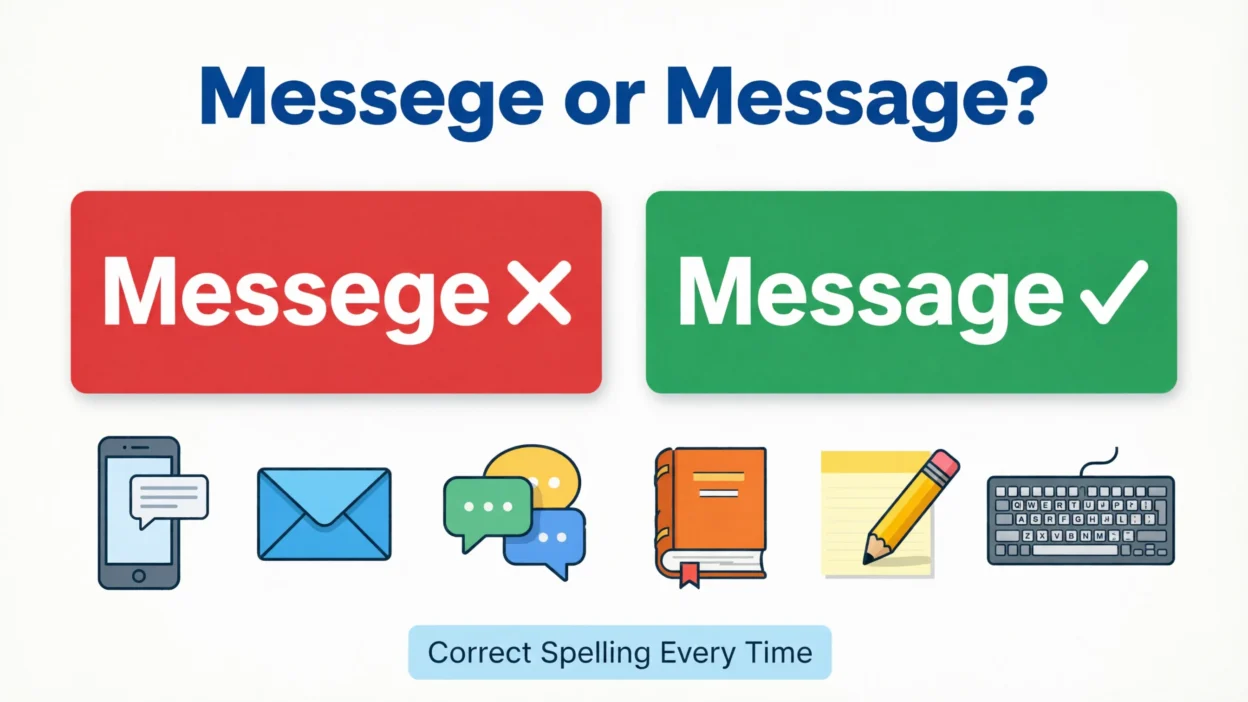
Messege or Message: Which One Is Correct?
The correct spelling is message.
❌ Messege — Incorrect
✅ Message — Correct
Although many people accidentally type messege, English dictionaries do not recognize it as a correct word.
Whenever you are writing an email, text message, school assignment, business report, or social media post, always use message.
What Does “Message” Mean?
A message is information that someone sends to another person.
It can be spoken, written, typed, emailed, or sent through a messaging app.
Examples
- I received your message this morning.
- She sent me a birthday message.
- Please read the message carefully.
- His message inspired everyone.
- The teacher left an important message.
Why Do People Write “Messege”?
Most spelling mistakes happen because English pronunciation can be confusing.
The middle sound of message does not clearly tell you whether it should contain a or e.
People often type words quickly on phones or keyboards, making accidental spelling mistakes more common.
Autocorrect usually fixes the mistake, but not always.
Message Meaning in Different Situations
Text Message
A short written communication sent through a mobile phone.
Example
She sent me a message before class.
Email Message
Information sent through email.
Example
I received your message this afternoon.
Important Message
An idea someone wants others to understand.
Example
The movie’s message was about kindness.
Hidden Message
A meaning that is not obvious at first.
Example
The poem carries a hidden message.
Common Examples of “Message”
- I received your message yesterday.
- Please reply to my message.
- She sent a kind message.
- Your message made me smile.
- The teacher shared an important message.
- He forgot to read the message.
- We wrote a welcome message.
- They posted a public message.
- Her message was clear.
- The message arrived late.
- Send me a message tonight.
- I deleted the wrong message.
- The manager wrote a short message.
- His message was encouraging.
- Everyone understood the message.
- She printed the message.
- The phone displayed a new message.
- They received the message safely.
- Your message answered my question.
- The farewell message touched everyone.
Message vs Messenger
People sometimes confuse message with messenger, but they have different meanings.
| Word | Meaning |
|---|---|
| Message | Information sent to someone |
| Messenger | A person or app that delivers messages |
Examples
- Please read my message.
- The messenger delivered the letter.
- I sent a message through Messenger.
Common Spelling Mistakes
Incorrect → Correct
- Messege → Message
- Mesage → Message
- Messsage → Message
- Messgae → Message
- Messaege → Message
Always remember that the correct spelling contains ss followed by age.
Tips to Remember the Correct Spelling
Here are a few simple tricks:
- Think of the ending -age in words like package, village, and message.
- Read your writing before sending it.
- Turn on spell check.
- Practice writing the word several times.
- Remember: there is no English word spelled messege.
Practice Exercise
Choose the correct spelling.
- I sent you a (messege/message).
- Please read my (messege/message).
- She deleted the wrong (messege/message).
- Did you receive my (messege/message)?
- Write a welcome (messege/message).
- His (messege/message) was helpful.
- The phone showed a new (messege/message).
- We shared an important (messege/message).
- Thank you for your kind (messege/message).
- I replied to your (messege/message).
Answers
- Message
- Message
- Message
- Message
- Message
- Message
- Message
- Message
- Message
- Message
Explanation: In every sentence, message is the correct spelling. Messege is never considered correct in standard English.
Frequently Asked Questions
Is “messege” a real word?
No. It is a spelling mistake.
Is “message” correct?
Yes. It is the only correct spelling in English.
Why do people write “messege”?
Usually because of typing errors, pronunciation confusion, or habit.
How do I remember the correct spelling?
Remember that message ends with -age, just like package and village.
Can I use “messege” in formal writing?
No. Always use message in school, work, emails, and professional writing.
Conclusion
Choosing between messege and message is easy once you know the rule. Message is the correct spelling in every situation, whether you’re sending a text, writing an email, or completing a school assignment. Messege is simply a common misspelling that should be avoided.
The easiest way to remember the correct spelling is to practice using message in everyday writing and proofread your work before sending it. With a little practice, you’ll never have to stop and wonder which spelling is right again.

Nick Mateo is a U.S.-based content writer at Aslikee who focuses on creating clear, reliable, and user-friendly content. He is passionate about delivering information that is easy to understand and genuinely helpful for readers.
He spends significant time researching topics to ensure accuracy and relevance. Nick believes that high-quality content is built on trust, transparency, and consistency, and he applies these principles in every article he works on.
At Aslikee, Nick contributes to maintaining strong editorial standards and improving the overall quality of the platform. His goal is to support users with well-structured, value-driven content that meets their needs.