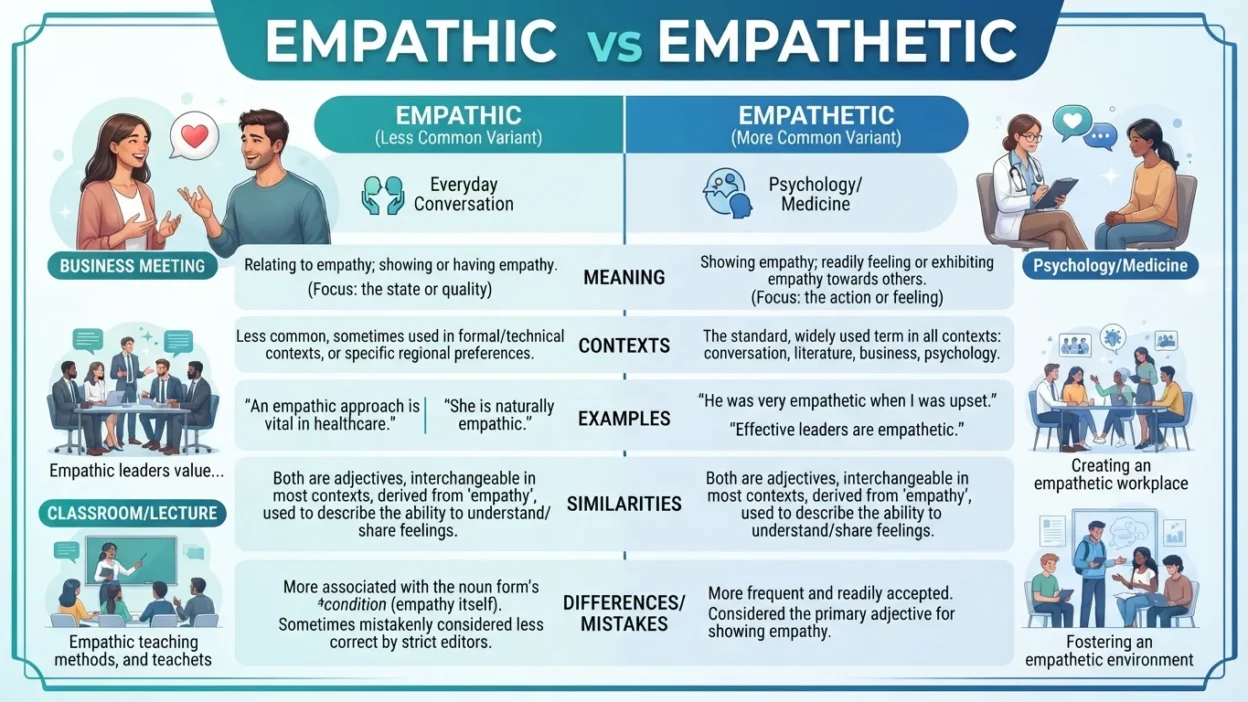
If you’re choosing between empathic or empathetic, both words are valid adjectives with a similar meaning and describe the ability to understand, share, and appreciate the feelings of another person while showing genuine care. From my experience, most people use empathetic in everyday conversation and business because it sounds warmer and more personal.
Many professionals, however, use empathic in clinical, scientific, and psychological contexts. When choosing between the two, think about your audience because the right word makes your writing feel more natural and appropriate.
Quick Answer
| Question | Answer |
|---|---|
| Are both words correct? | Yes |
| Which is more common? | Empathetic |
| Which is used in psychology and science? | Empathic |
| Do they have the same meaning? | Almost always |
| Which should you use in daily writing? | Empathetic |
What Is the Difference Between Empathic and Empathetic?
Both empathic and empathetic are adjectives that describe someone who can understand and share another person’s emotions.
The biggest difference is usage rather than meaning.
| Empathic | Empathetic |
|---|---|
| Common in psychology and clinical writing | Common in everyday conversation |
| Frequently used in scientific contexts | Frequently used in business and general writing |
| Slightly more technical | Sounds warmer and more natural |
For most people, either word is acceptable, but choosing the one that matches your audience improves clarity.
What Does Empathic Mean?
Empathic describes a person’s ability to understand another person’s emotions and experiences.
It is commonly found in:
- Psychology
- Counseling
- Psychiatry
- Research papers
- Medical writing
Examples
- The therapist remained empathic throughout the session.
- An empathic response helps patients feel understood.
- Researchers studied empathic behavior in children.
- Clinical psychologists encourage empathic listening.
What Does Empathetic Mean?
Empathetic has essentially the same meaning but is much more common in everyday English.
You’ll often hear it in:
- Workplace communication
- Customer service
- Leadership
- Education
- Daily conversations
Examples
- She gave an empathetic reply after hearing the news.
- Good managers are empathetic leaders.
- Teachers should be empathetic toward struggling students.
- His empathetic nature made everyone feel comfortable.
Empathic vs Empathetic Comparison
| Feature | Empathic | Empathetic |
|---|---|---|
| Meaning | Understanding another’s feelings | Understanding another’s feelings |
| Grammar | Adjective | Adjective |
| Everyday English | Less common | More common |
| Psychology | Very common | Common |
| Business writing | Sometimes | Frequently |
| Scientific writing | Preferred | Less common |
Why Do Both Words Exist?
The words developed from the noun empathy, which describes the ability to understand another person’s emotions.
Over time, both adjective forms became accepted. Today, dictionaries recognize empathic and empathetic as correct, although their popularity varies depending on the context and writing style.
When Should You Use Empathic?
Choose empathic when writing for professional or academic audiences. It fits naturally in fields where emotional understanding is studied or discussed in a technical way.
Common areas include:
- Psychology
- Psychiatry
- Counseling
- Social work
- Medical research
- Scientific journals
Example Sentences
- The counselor showed an empathic approach during therapy.
- Researchers measured empathic responses in participants.
- Doctors benefit from empathic communication with patients.
When Should You Use Empathetic?
Use empathetic in everyday writing and conversation. It sounds more natural to most English speakers and is widely accepted in personal and professional communication.
You’ll often see it in:
- Emails
- Customer service
- Leadership training
- Schools
- Blogs
- Workplace discussions
Example Sentences
- She gave an empathetic response to her friend’s problem.
- An empathetic manager builds stronger teams.
- Parents should remain empathetic during difficult conversations.
Real-Life Examples
Here are examples showing both words used correctly.
| Situation | Better Choice |
|---|---|
| Psychology textbook | Empathic |
| Scientific research paper | Empathic |
| Therapy discussion | Empathic |
| Business email | Empathetic |
| Customer support | Empathetic |
| Everyday conversation | Empathetic |
| Leadership advice | Empathetic |
Common Mistakes to Avoid
Many learners misunderstand these two words. Here are the most common mistakes.
| Mistake | Better Choice |
|---|---|
| Thinking one word is incorrect | Both are correct |
| Using empathic in casual writing when warmth is preferred | Use empathetic |
| Believing they have different definitions | Their meanings are nearly identical |
| Mixing styles without considering the audience | Match the context |
Easy Trick to Remember
A simple way to remember the difference is this:
- Empathetic = everyday conversations and business.
- Empathic = psychology, medicine, and science.
If you’re unsure, empathetic is usually the safer choice because it’s more familiar to general readers.
Interesting Facts
- Both words come from the noun empathy.
- Major English dictionaries recognize both spellings.
- Empathetic has become increasingly common in business and leadership writing.
- Empathic remains popular in academic and clinical publications.
- Native English speakers often use the two words interchangeably in conversation.
Future Outlook
The debate over empathic or empathetic is likely to continue, but both words are firmly established in modern English. As mental health, emotional intelligence, and effective communication receive more attention, both terms will remain valuable. Empathetic will probably stay the preferred choice in everyday language, while empathic will continue to be widely used in psychology, medicine, and scientific research.
Writers no longer need to worry about choosing a “wrong” word. The best choice depends on your audience and the tone of your writing.
Frequently Asked Questions
Is it empathic or empathetic?
Both empathic and empathetic are correct. They have nearly the same meaning, but empathetic is more common in everyday English.
Which word is more common?
Empathetic is generally more common in conversation, business writing, and online content, while empathic is often preferred in clinical and scientific contexts.
Do empathic and empathetic mean the same thing?
Yes. Both describe the ability to understand and share another person’s feelings. The difference is mainly in style and context rather than meaning.
Should I use empathic in business writing?
You can, but empathetic is usually the better choice because it sounds warmer and more natural to general readers.
Is empathic used in psychology?
Yes. Empathic is commonly used in psychology, counseling, psychiatry, and other clinical or scientific fields.
Final Thoughts
Choosing between empathic or empathetic is easier than it first appears. Both words are correct and share the same core meaning. If you’re writing for everyday readers, empathetic is usually the best option. If you’re writing for a clinical, psychological, or scientific audience, empathic may fit the context better. Matching the word to your audience will make your writing feel clear, natural, and professional.

Robert Parker is a U.S.-based author at Aslikee who is dedicated to producing accurate and trustworthy content for readers. He focuses on presenting information in a clear and organized way, making complex topics easier to understand.
He values thorough research and careful fact-checking to ensure every piece of content meets high quality standards. Robert believes that consistency and reliability are essential for building long-term reader trust.
At Aslikee, Robert plays an important role in supporting editorial quality and content improvement. His goal is to help users access useful, well-structured information that adds real value to their experience.