Have you ever wondered whether you should write check or cheque? The answer depends on what you mean and which variety of English you’re using. This small spelling difference often confuses learners because both words are correct in different situations.
In American English, check is used for almost everything. In British English, however, cheque is the preferred spelling when referring to a bank payment, while check has several other meanings.
This guide explains the difference between check or cheque, shows when to use each one, and helps you choose the correct spelling with confidence.
Quick Answer
| Question | Answer |
|---|---|
| Correct US spelling for bank payment | Check |
| Correct UK spelling for bank payment | Cheque |
| UK spelling for inspect or verify | Check |
| American English preference | Check |
| British English preference | Cheque (bank payment), Check (other meanings) |
What Is the Difference Between Check and Cheque?
The main difference is based on regional English and meaning.
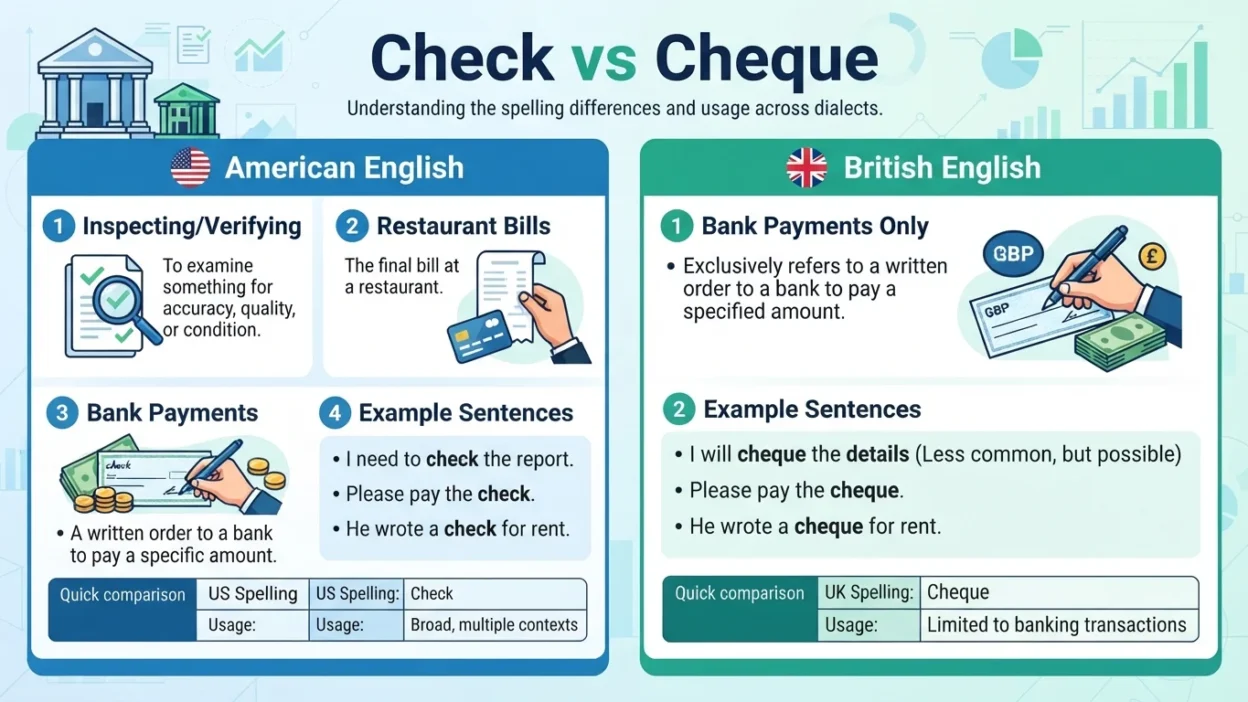
A check can mean to inspect, verify, examine, stop, or mark something as correct. In American English, it is also the spelling for a written bank payment.
A cheque is used mainly in British English and other Commonwealth countries to mean a written order instructing a bank to pay money.
| Check | Cheque |
|---|---|
| Used in American English for bank payments | Used in British English for bank payments |
| Means inspect or verify | Refers only to a bank payment |
| Can be a noun or verb | Used only as a noun |
What Does Check Mean?
The word check has several meanings.
It may refer to:
- Looking at something carefully
- Verifying information
- Inspecting for mistakes
- Marking something as complete
- A written bank payment in American English
- A restaurant bill in American English
Example Sentences
- Please check your homework before submitting it.
- I need to check my email.
- She paid by check.
- The teacher checked every answer carefully.
What Does Cheque Mean?
A cheque is a written document that tells a bank to pay a specific amount of money from one account to another.
It is commonly used in:
- United Kingdom
- Canada
- Australia
- New Zealand
- India
- Pakistan
Although electronic payments are becoming more popular, cheques are still used by some businesses and organizations.
Example Sentences
- She wrote a cheque for the rent.
- The bank accepted my cheque.
- Please sign the cheque before handing it over.
Check vs Cheque Comparison
| Feature | Check | Cheque |
|---|---|---|
| American English | ✅ Yes | ❌ No |
| British English | ✅ Yes (general meanings) | ✅ Yes (bank payment) |
| Refers to payment | ✅ US English | ✅ UK English |
| Means inspect or verify | ✅ Yes | ❌ No |
| Can be used as a verb | ✅ Yes | ❌ No |
Why Do the Spellings Differ?
The difference comes from the evolution of British and American English.
American English gradually simplified many spellings, choosing check for financial documents as well. British English kept cheque specifically for banking while continuing to use check for inspection and verification.
When Should You Use Check?
Use check whenever you mean to inspect, examine, verify, test, or confirm something. It is also the correct spelling for a bank payment in American English.
Common situations include:
- Checking your homework
- Checking your email
- Checking your luggage
- Checking a document for mistakes
- Paying by check in the United States
Example Sentences
- Please check the report before sending it.
- I always check the weather before traveling.
- He paid the bill by check.
- The mechanic checked the engine carefully.
When Should You Use Cheque?
Use cheque only when referring to a written bank payment in British English and many Commonwealth countries.
You should use cheque if you’re writing for readers in:
- United Kingdom
- Canada
- Australia
- New Zealand
- India
- Pakistan
Example Sentences
- I deposited a cheque yesterday.
- She signed the cheque before giving it to the cashier.
- The company mailed my salary cheque.
- The bank processed the cheque within two days.
Common Mistakes to Avoid
Many learners mix the spellings because they look similar. The easiest way to avoid mistakes is to think about your audience and the meaning.
| Incorrect Usage | Correct Usage |
|---|---|
| Please cheque your homework. | Please check your homework. |
| I wrote a check for rent. (UK English) | I wrote a cheque for rent. |
| I deposited a cheque. (US English) | I deposited a check. |
| Can you cheque this email? | Can you check this email? |
Check or Cheque in American and British English
| Situation | American English | British English |
|---|---|---|
| Bank payment | Check | Cheque |
| Inspect something | Check | Check |
| Verify information | Check | Check |
| Restaurant bill | Check | Bill |
| Mark something correct | Check | Check |
This table shows that cheque has only one main purpose, while check has several meanings.
Real-Life Examples
You may notice the difference while traveling or reading international websites.
For example:
- In New York, a landlord may ask you to pay by check.
- In London, the same payment would usually be made by cheque.
- Teachers everywhere ask students to check their answers before submitting a test.
From my experience, remembering your audience makes choosing the correct spelling much easier.
Interesting Facts
- Cheque comes from older banking terminology used in British English.
- American English later standardized check for both financial and general uses.
- Digital payments have reduced the use of paper checks and cheques, but both terms are still widely recognized.
- Spell-check tools usually adapt to the English variety you select, helping you use the correct spelling automatically.
Future Outlook
Paper checks and cheques are becoming less common as online banking, mobile payment apps, and digital transfers continue to grow. However, many businesses, government offices, charities, and legal organizations still accept or issue them. Because both British and American English remain widely used around the world, understanding the difference between check and cheque will continue to be valuable.
Whether you’re writing an email, filling out banking forms, or creating business documents, using the correct spelling for your audience helps your writing look accurate and professional.
Frequently Asked Questions
Is it check or cheque?
Both are correct. Use check in American English. Use cheque in British English when referring to a bank payment.
Is cheque used in the United States?
No. American English uses check for written bank payments. The spelling cheque is generally not used in the United States.
Why does British English use cheque?
British English keeps cheque as the standard spelling for a written bank payment to distinguish it from the many other meanings of check.
Can check be used as a verb?
Yes. Check is commonly used as a verb meaning to inspect, examine, verify, or confirm something. Cheque is never used as a verb.
Which spelling should I use in international writing?
Choose the spelling that matches your audience. If you’re writing for American readers, use check. For British or many Commonwealth readers, use cheque when referring to bank payments.
Final Thoughts
Choosing between check or cheque is easy once you know the context. Check is the standard American spelling and also the universal choice for meanings like inspect or verify. Cheque is the British spelling used specifically for written bank payments. Matching your spelling to your audience will make your writing clearer and more natural.

Robert Parker is a U.S.-based author at Aslikee who is dedicated to producing accurate and trustworthy content for readers. He focuses on presenting information in a clear and organized way, making complex topics easier to understand.
He values thorough research and careful fact-checking to ensure every piece of content meets high quality standards. Robert believes that consistency and reliability are essential for building long-term reader trust.
At Aslikee, Robert plays an important role in supporting editorial quality and content improvement. His goal is to help users access useful, well-structured information that adds real value to their experience.