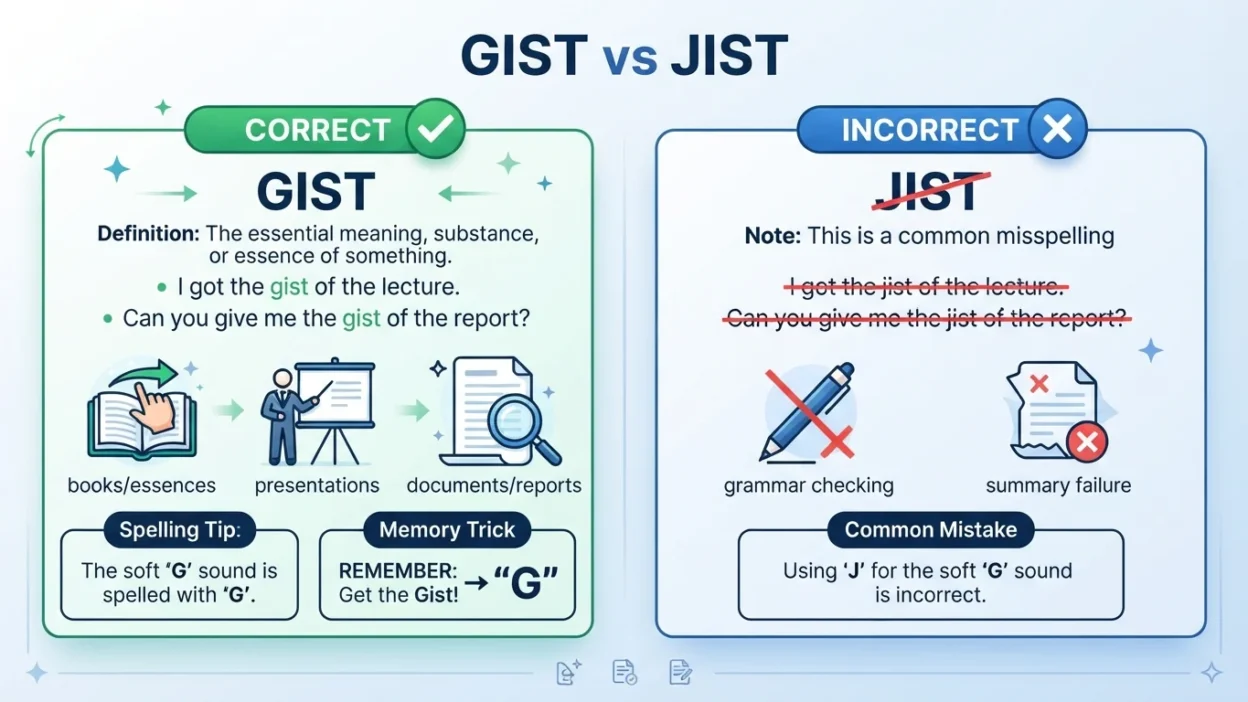
When comparing gist or jist, remember that gist is the correct spelling. It is a noun meaning the most important idea or essence of something, and it can also refer to the grounds of a legal action. It is normally used with the definite article, the, instead of the indefinite article, a. From my experience, this simple rule makes everyday writing much easier.
The spelling jist is a misspelling and should not be used. A QuillBot Grammar Checker catches and automatically corrects common mistakes like this. In a sentence, you may read a summary to get the gist of a novel’s plot, or ask someone to give me the gist of a presentation in a few sentences. Avoid phrases like get the jist or give me the jist because gist is always the correct form.
Quick Answer
| Question | Answer |
|---|---|
| Correct spelling | Gist |
| Incorrect spelling | Jist |
| Part of speech | Noun |
| Meaning | The main idea or essence of something |
| Can “jist” be used? | No, except as an intentional stylized spelling or typo |
| Common expression | Get the gist |
What Is the Difference Between Gist and Jist?
The difference is straightforward.
Gist is the correct English word. It refers to the main point, central meaning, or essential idea of something.
Jist is simply a misspelling. Although many people type it because of pronunciation, it is not accepted in standard English dictionaries.
| Gist | Jist |
|---|---|
| Correct spelling | Incorrect spelling |
| Standard English | Misspelling |
| Means main idea | Has no accepted meaning |
| Used in writing and speech | Should be avoided |
What Does Gist Mean?
The word gist refers to the most important part of something.
You might hear someone say:
- “What’s the gist of the meeting?”
- “I got the gist of the story.”
- “Can you explain the gist of the article?”
In legal English, gist can also refer to the essential grounds of a legal action, although this meaning is less common in everyday conversation.
Why Do People Write “Jist”?
The confusion happens because gist is pronounced with a J sound.
Many English words begin with the letter G but sound like J, including:
- Giant
- Giraffe
- General
- Genius
Because of this pronunciation pattern, people sometimes assume jist is the correct spelling.
Common Examples of Gist
Here are some natural examples.
| Correct Sentence | Why It’s Correct |
|---|---|
| I got the gist of the presentation. | Refers to the main idea. |
| She explained the gist in two minutes. | Means the essential point. |
| I understand the gist of the novel. | Refers to the central meaning. |
| Can you summarize the gist? | Means the key message. |
Notice that jist never appears in correct examples.
Is Jist Ever Correct?
In standard English, no.
However, you might occasionally see jist used:
- As a typo
- In fictional dialogue to represent pronunciation
- As part of a brand or username
These situations do not make jist a correct dictionary spelling.
Easy Trick to Remember
Here’s a simple memory tip.
Think of gist as the general idea.
Both general and gist begin with the letter G. This connection makes it easier to remember the correct spelling whenever you write.
Gist vs Jist Comparison
If you’re still unsure which spelling to use, this table makes the choice easy.
| Feature | Gist | Jist |
|---|---|---|
| Correct English spelling | ✅ Yes | ❌ No |
| Found in dictionaries | ✅ Yes | ❌ No |
| Means the main idea | ✅ Yes | ❌ No |
| Suitable for school writing | ✅ Yes | ❌ No |
| Suitable for business writing | ✅ Yes | ❌ No |
| Common spelling mistake | ❌ No | ✅ Yes |
When Should You Use Gist?
Use gist whenever you’re talking about the main point, central meaning, or overall message of something.
Common situations include:
- Summarizing a book
- Explaining a meeting
- Discussing a presentation
- Talking about a movie
- Writing an email
- Giving a quick overview
Example Sentences
- I understood the gist after reading the summary.
- Can you tell me the gist of today’s lecture?
- She explained the gist of the proposal in just a few minutes.
- I didn’t read every page, but I got the gist.
Common Mistakes to Avoid
Many writers accidentally type jist because they write the word exactly as it sounds.
Here are mistakes to watch for.
| Incorrect | Correct |
|---|---|
| I got the jist. | I got the gist. |
| What’s the jist? | What’s the gist? |
| Give me the jist. | Give me the gist. |
| I understand the jist of the report. | I understand the gist of the report. |
Using gist every time will help your writing look more professional.
Why Is Gist Pronounced Like “Jist”?
English pronunciation does not always match spelling.
The letter G has both a hard and a soft sound.
Examples with the soft G sound include:
- Giant
- General
- Giraffe
- Gesture
- Genius
- Gist
Since these words sound like they begin with J, it’s easy to understand why many learners mistakenly write jist.
Real-Life Examples
You’ll often hear gist in everyday conversations.
For example:
- A teacher may say, “Did everyone understand the gist of today’s lesson?”
- A manager might ask, “Can you give me the gist of the meeting?”
- A friend could say, “I didn’t finish the movie, but I got the gist.”
I’ve noticed that once people connect gist with “main idea,” they rarely make the spelling mistake again.
Interesting Facts
- Gist has been part of English for centuries.
- It comes from an older legal meaning referring to the essential point of a case.
- Today, it is much more commonly used to mean the main idea or essence of something.
- Spell-check tools immediately recognize gist but usually flag jist as an error.
- The phrase “get the gist” is one of the most common expressions using the word.
Future Outlook
As digital writing continues to grow, more people rely on spell checkers and grammar tools to catch small spelling mistakes. Because of this, gist will remain the accepted spelling in dictionaries, schools, businesses, and professional writing. Although jist may still appear as a typing mistake or in casual online posts, it is unlikely to become a standard English word.
Learning the correct spelling today helps you communicate more clearly and leaves a better impression in academic, personal, and workplace writing.
Frequently Asked Questions
Is it gist or jist?
The correct spelling is gist. Jist is a misspelling and should not be used in standard English.
What does gist mean?
Gist means the main idea, central point, or essence of something. People often use it when talking about summaries or quick explanations.
Why do people spell gist as jist?
Many people spell it as jist because gist is pronounced with a soft “G” that sounds like the letter “J.” The pronunciation causes confusion, but the spelling remains gist.
Can I use jist in formal writing?
No. Jist is not considered correct English. In formal writing, school assignments, emails, and professional documents, always use gist.
What is the phrase “get the gist” mean?
The phrase “get the gist” means to understand the main idea or most important part of something without knowing every detail.
Final Thoughts
Choosing between gist or jist is simple once you know the rule. Gist is the only correct spelling and is used whenever you want to describe the main idea or essence of something. While jist may sound right because of pronunciation, it is a spelling mistake. Remember this one rule, and you’ll avoid a common English error with confidence.

William Cooper is a U.S.-based content writer at Aslikee who focuses on creating clear, informative, and user-friendly content. He is committed to delivering information that is accurate, practical, and easy for readers to understand.
He believes that strong content comes from careful research and attention to detail. William takes time to ensure that each article meets quality standards and provides real value to users.
At Aslikee, William contributes to maintaining editorial consistency and improving content quality. His goal is to support readers with reliable information and help build long-term trust in the platform.