If you’ve ever written eyeing or eying, you may have wondered which spelling is correct. Since both versions appear online and in different dictionaries, it’s easy to feel uncertain.
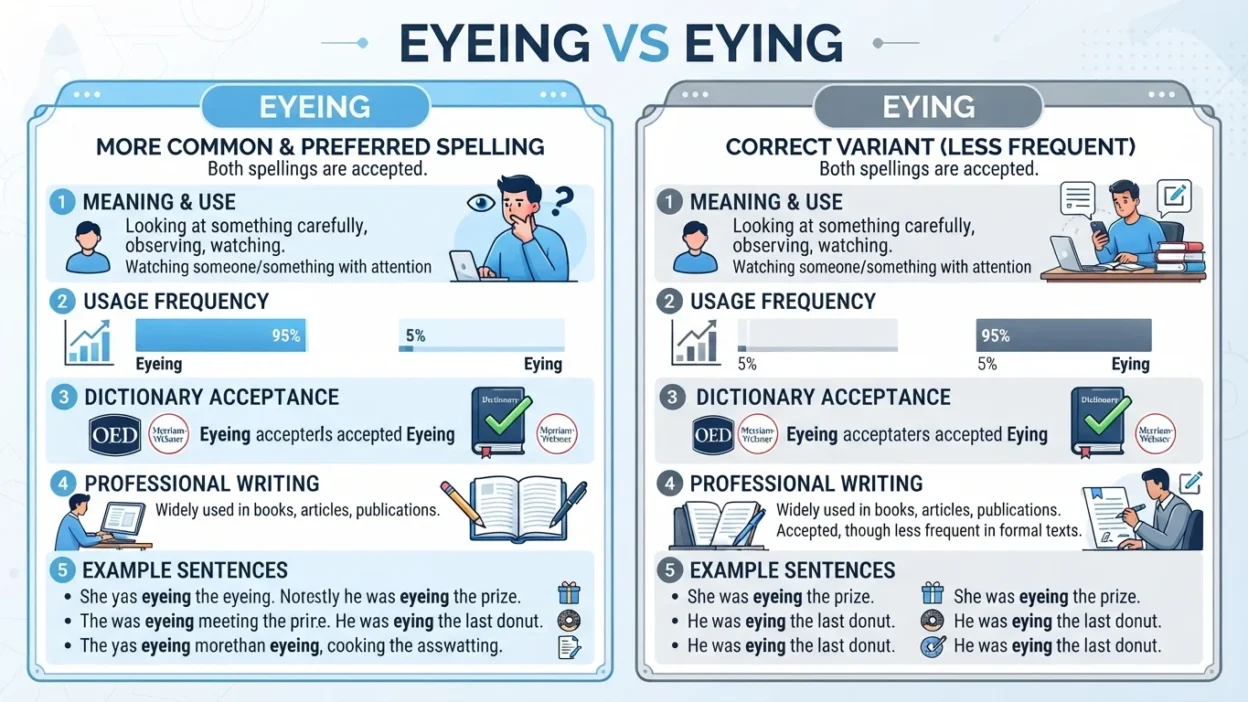
The good news is that eyeing and eying are both accepted spellings of the present participle and gerund of the verb eye, meaning to look at someone or something carefully, closely, or with interest. However, one spelling is much more common.
This guide explains the difference between eyeing or eying, when to use each form, and which spelling is generally preferred.
Quick Answer
| Question | Answer |
|---|---|
| Are both spellings correct? | Yes |
| Most common spelling | Eyeing |
| Less common spelling | Eying |
| Meaning | Looking at someone or something carefully |
| Best choice for most writing | Eyeing |
What Do Eyeing and Eying Mean?
Both eyeing and eying are the present participle and gerund forms of the verb eye.
They mean looking at, watching, considering, or observing someone or something with attention or interest.
For example:
- She was eyeing the last slice of cake.
- He kept eying the new sports car.
The meaning is identical regardless of the spelling.
Is It Eyeing or Eying?
Both spellings are correct.
However, eyeing is by far the more common spelling in modern English. It appears more frequently in dictionaries, books, newspapers, and professional writing.
Eying is accepted but is used much less often.
If you’re unsure which spelling to choose, eyeing is usually the safest option.
Why Are There Two Spellings?
The verb eye ends with the silent letter e.
Normally, English drops the final e before adding -ing, which creates eying. However, many writers prefer eyeing because it keeps the original word eye visually clear and easier to read.
Over time, both spellings became accepted, but eyeing became much more popular.
| Feature | Eyeing | Eying |
|---|---|---|
| Correct spelling | ✅ | ✅ |
| More common | ✅ | ❌ |
| Dictionary acceptance | ✅ | ✅ |
| Professional writing | Preferred | Less common |
| Meaning | Same | Same |
When Should You Use Eyeing?
For most situations, eyeing is the recommended spelling.
You’ll commonly see it in:
- Books
- Newspapers
- Online articles
- Business writing
- Academic writing
- Professional communication
Example Sentences
- She was eyeing the new laptop in the store.
- The cat kept eyeing the bird outside the window.
- Investors are eyeing new opportunities this year.
When Should You Use Eying?
Although less common, eying is still a correct spelling.
You may find it in:
- Some dictionaries
- Informal writing
- Older publications
- Personal writing styles
Example Sentences
- He was eying the empty seat near the window.
- They spent the afternoon eying different houses.
- She kept eying the dessert menu.
Eyeing vs Eying Comparison
Although both spellings are accepted, eyeing is much more common in modern English and is generally the preferred choice.
| Feature | Eyeing | Eying |
|---|---|---|
| Meaning | Looking carefully or with interest | Looking carefully or with interest |
| Correct spelling | Yes | Yes |
| Most common spelling | Yes | No |
| Dictionary acceptance | Yes | Yes |
| Professional writing | Preferred | Less common |
| Everyday writing | Very common | Uncommon |
Common Mistakes to Avoid
Many writers become confused because English usually drops the final e before adding -ing.
Avoid these common mistakes:
- Thinking eying is incorrect.
- Assuming eyeing is a spelling mistake because it keeps the extra e.
- Switching between eyeing and eying within the same document.
- Choosing the less common spelling when consistency or readability matters.
For most readers, eyeing looks more familiar and is easier to recognize.
Real-Life Examples
Here are a few natural examples of both spellings.
- The customer was eyeing the newest smartphone before making a purchase.
- The dog kept eyeing the food on the table.
- Investors are eyeing new markets for future growth.
- She spent several minutes eying the artwork before making her decision.
From my experience, eyeing appears much more often in books, news articles, and professional content, making it the better choice for most situations.
Interesting Facts
| Fact | Explanation |
|---|---|
| Both spellings are accepted | Dictionaries recognize both eyeing and eying. |
| Eyeing is more common | It appears more frequently in modern publications. |
| Same meaning | Both describe looking at something carefully or with interest. |
| Spelling pattern | Eyeing preserves the original word eye, making it easier to recognize. |
| Professional preference | Most editors recommend eyeing for clarity and consistency. |
Future Outlook
Both spellings are expected to remain correct, but eyeing will likely continue to dominate in books, journalism, business writing, and online publications.
Because it is the more familiar spelling, new learners and professional writers are more likely to choose eyeing, while eying will probably remain an accepted but less common alternative.
Frequently Asked Questions
Is it eyeing or eying?
Both eyeing and eying are correct spellings. However, eyeing is the more common and widely preferred form in modern English.
Why is eyeing more common than eying?
Many writers prefer eyeing because it keeps the original word eye easy to recognize. It is also the spelling most often found in books, newspapers, and professional writing.
Is eying incorrect?
No. Eying is a valid spelling recognized by dictionaries. It is simply much less common than eyeing.
Which spelling should I use in formal writing?
For formal writing, eyeing is usually the better choice because it is the spelling most readers expect and most editors recommend.
Do eyeing and eying have different meanings?
No. Both words mean looking at, watching, or considering someone or something carefully or with interest. The spelling does not change the meaning.
Final Thoughts
Choosing between eyeing or eying is easier than it first appears. Both spellings are correct, but eyeing is the standard choice in most modern writing because it is more familiar and easier to recognize. While eying remains an accepted alternative, using eyeing will make your writing look more natural and professional to most readers.

Robert Parker is a U.S.-based author at Aslikee who is dedicated to producing accurate and trustworthy content for readers. He focuses on presenting information in a clear and organized way, making complex topics easier to understand.
He values thorough research and careful fact-checking to ensure every piece of content meets high quality standards. Robert believes that consistency and reliability are essential for building long-term reader trust.
At Aslikee, Robert plays an important role in supporting editorial quality and content improvement. His goal is to help users access useful, well-structured information that adds real value to their experience.