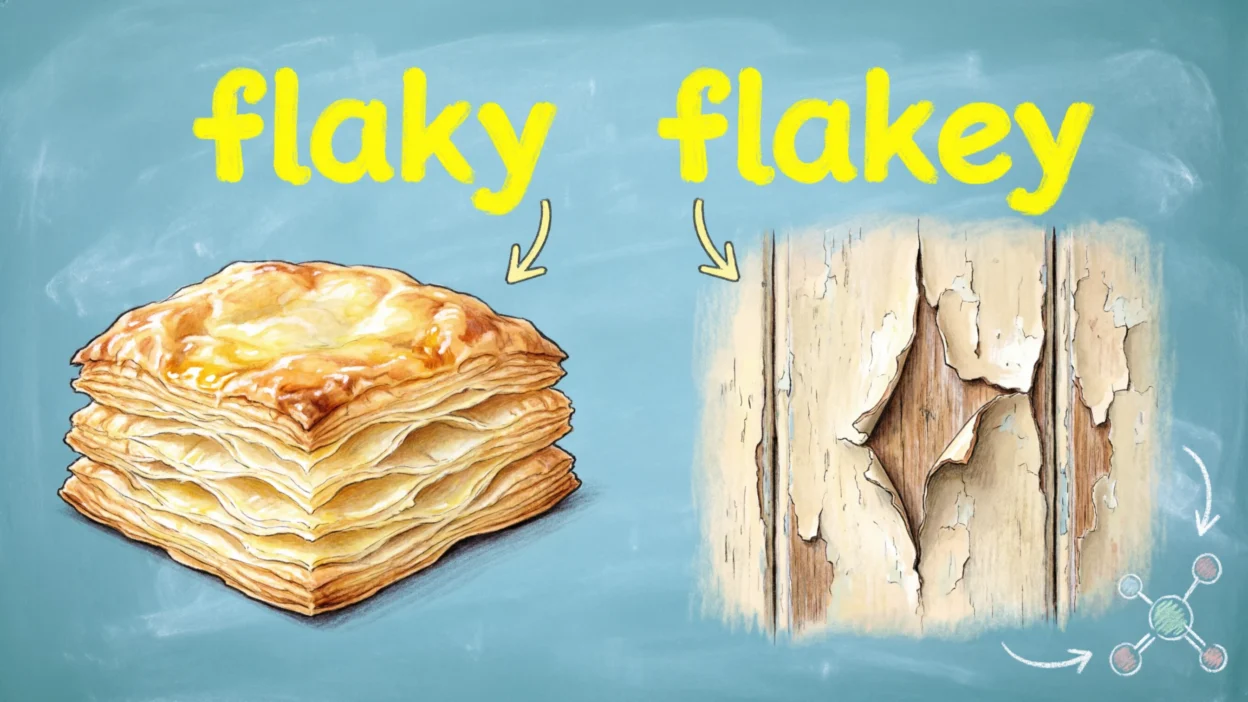
Many people wonder whether the correct spelling is “flakey” or “flaky.” Since both versions appear online, it can be confusing to know which one to use.
The simple answer is:
👉 Both “flakey” and “flaky” are accepted spellings.
However, “flaky” is far more common and is usually the preferred spelling in modern English.
👉 For example:
- The pie crust was flaky and delicious.
- He has a flaky personality.
Most dictionaries and writers use flaky more often.
What Does “Flaky” Mean?
Flaky can describe:
- Something that breaks into thin layers
- A person who is unreliable or forgetful
👉 This is the most common spelling.
Examples:
- The biscuits were warm and flaky.
- Her skin became dry and flaky.
- He is flaky and often misses meetings.
- The pastry had a flaky texture.
What Does “Flakey” Mean?
Flakey has the same meaning as flaky.
👉 It is simply a less common spelling variation.
Examples:
- The crust looked flakey.
- Some writers still use flakey in casual writing.
- The paint became old and flakey.
Flakey vs Flaky (Quick Comparison)
| Word | Correct? | Common Usage |
|---|---|---|
| Flakey | ✔️ Yes | Less common |
| Flaky | ✔️ Yes | Most common and preferred |
👉 Important:
Both spellings are correct, but flaky is usually the better choice.
Sentence Examples
Using “Flaky”
- The cake had a flaky crust.
- He can be flaky sometimes.
- The old paint looked flaky.
Using “Flakey”
- The cookies were flakey and crisp.
- Her skin appeared flakey in winter.
- The walls became flakey with age.
Common Mistakes
❌ The pie was very flakes.
✔️ The pie was very flaky.
❌ He is a flakey friend who forgets plans.
✔️ He is a flaky friend who forgets plans.
👉 Remember:
- Modern and common spelling → flaky
Practice Time
Fill in the blanks:
- The pastry was warm and ______.
- His unreliable behavior seemed ______.
- The old paint looked dry and ______.
- The biscuits had a ______ texture.
- She described the crust as ______.
Answers:
- flaky / flakey
- flaky / flakey
- flaky / flakey
- flaky / flakey
- flaky / flakey
Easy Memory Trick
👉 Think like this:
- Most modern words ending in -y are shorter and simpler.
- That’s why flaky is the spelling most people use today.
If you are unsure, choose flaky because it is more natural in modern English.
Final Thought
Both flaky and flakey are accepted spellings, but flaky is much more common in modern writing and conversation. Whether you are describing food, skin, paint, or a person’s behavior, using flaky will usually sound more natural and widely accepted. Learning spelling variations like this can make your English more polished and confident.