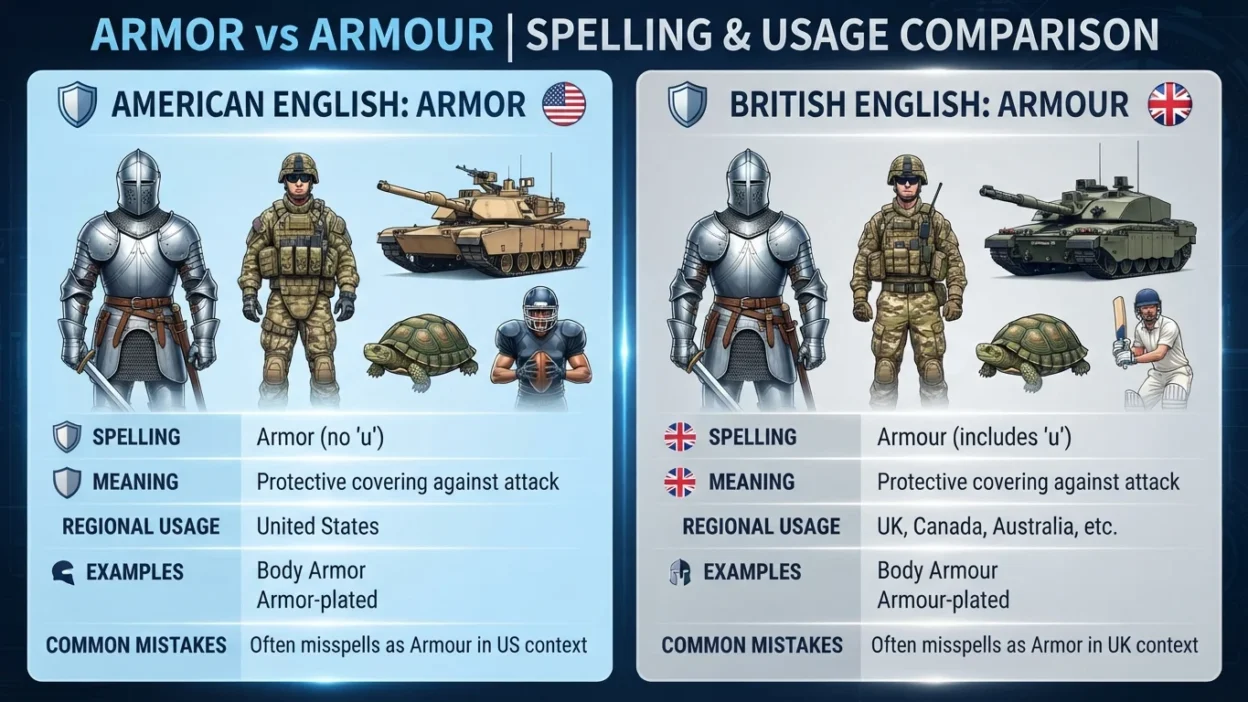
If you’ve ever written armor and then seen armour somewhere else, you may have wondered which spelling is correct. The answer is simple: both are correct, but the right choice depends on the type of English you’re using.
The difference between armor or armour is not about meaning. Both words describe protective covering worn by people, animals, or vehicles. The only distinction is regional spelling.
In this guide, you’ll learn the difference between armor and armour, where each spelling is used, common examples, and how to choose the correct one for your writing.
Quick Answer
| Question | Answer |
|---|---|
| Are both spellings correct? | Yes |
| Which spelling is American English? | Armor |
| Which spelling is British English? | Armour |
| Do they have different meanings? | No |
| Which spelling should I use? | Match your audience |
| Can both refer to protective equipment? | Yes |
What Is the Difference Between Armor and Armour?
The only real difference between armor and armour is spelling.
Both words refer to protective equipment designed to reduce injury from weapons, impacts, or other dangers. Whether you’re talking about medieval knights, military vehicles, or protective clothing, the meaning stays the same.
| American English | British English |
|---|---|
| Armor | Armour |
If you’re writing for readers in the United States, armor is the preferred spelling. If your audience is in the United Kingdom or many Commonwealth countries, armour is standard.
What Does Armor Mean?
In American English, armor refers to any protective covering designed to defend against harm.
It can describe:
- Body armor
- Military armor
- Tank armor
- Protective sports gear
- Animal armor, such as turtle shells
Examples
- The soldier wore body armor during the mission.
- Modern tanks use advanced armor.
- The knight polished his armor before the tournament.
- Some animals have natural armor for protection.
What Does Armour Mean?
Armour has exactly the same meaning as armor.
It simply follows British English spelling rules.
Examples include:
- The museum displayed medieval armour.
- The knight repaired his armour before battle.
- Modern military vehicles use reinforced armour.
- Protective armour improves battlefield safety.
Armor vs Armour Comparison Table
| Feature | Armor | Armour |
|---|---|---|
| Meaning | Protective covering | Protective covering |
| American English | ✔ Preferred | Less common |
| British English | Less common | ✔ Preferred |
| Military writing | ✔ | ✔ |
| Historical writing | ✔ | ✔ |
| Sports protection | ✔ | ✔ |
Why Are There Two Spellings?
The difference between armor and armour comes from the spelling traditions of American and British English.
American English often removes the letter “u” from words ending in -our, while British English keeps it. This spelling pattern appears in many common words.
| American English | British English |
|---|---|
| Armor | Armour |
| Color | Colour |
| Honor | Honour |
| Favor | Favour |
| Labor | Labour |
Neither spelling is more correct than the other. The best choice depends on the audience you’re writing for.
Common Uses of Armor and Armour
Both spellings are used across many subjects and industries.
Military
Armor protects soldiers and military vehicles from bullets, explosions, and other threats.
Examples:
- Modern armor is made from advanced materials.
- The vehicle’s armour resisted heavy damage.
History
Knights wore metal armor during the Middle Ages to protect themselves in battle.
Examples:
- The knight’s armor weighed over 20 kilograms.
- Medieval armour was carefully crafted by skilled blacksmiths.
Sports
Protective equipment is also called armor in many sports.
Examples include:
- Motorcycle armor
- Hockey body armor
- Protective riding armor
Animals
Nature has its own examples of armor.
Animals such as turtles, armadillos, and pangolins have natural protective coverings that act like armor against predators.
Real-Life Examples
Here are examples using both spellings correctly.
American English
- The firefighter wore protective armor.
- Engineers improved the tank’s armor.
- The museum displayed ancient armor.
British English
- The firefighter wore protective armour.
- Engineers improved the vehicle’s armour.
- The castle displayed medieval armour.
Notice that only the spelling changes. The meaning stays exactly the same.
Common Mistakes to Avoid
Many writers accidentally mix regional spellings.
| Mistake | Better Choice |
|---|---|
| Using armor and armour in the same article | Stay consistent |
| Using armour in US business writing | Use armor |
| Using armor in UK publications | Use armour |
| Thinking one spelling is incorrect | Both are correct |
| Switching spellings halfway through | Match your audience throughout |
Which Spelling Should You Choose?
Choose armor if you’re writing for:
- American readers
- US businesses
- American schools
- US news websites
Choose armour if you’re writing for:
- British readers
- UK publications
- Australian audiences
- Canadian publications that follow British spelling
Consistency is more important than the spelling itself. Pick one version and use it throughout your document.
Interesting Facts About Armor
- The earliest forms of armor were made from leather, animal hides, and bronze.
- Medieval plate armor provided excellent protection while still allowing movement.
- Modern body armor often uses lightweight materials such as Kevlar and ceramic plates.
- Many fantasy books, movies, and video games use both armor and armour, depending on the language style they follow.
Why Are There Two Spellings?
The difference between armor and armour comes from the spelling traditions of American and British English.
American English often removes the letter “u” from words ending in -our, while British English keeps it. This spelling pattern appears in many common words.
| American English | British English |
|---|---|
| Armor | Armour |
| Color | Colour |
| Honor | Honour |
| Favor | Favour |
| Labor | Labour |
Neither spelling is more correct than the other. The best choice depends on the audience you’re writing for.
Common Uses of Armor and Armour
Both spellings are used across many subjects and industries.
Military
Armor protects soldiers and military vehicles from bullets, explosions, and other threats.
Examples:
- Modern armor is made from advanced materials.
- The vehicle’s armour resisted heavy damage.
History
Knights wore metal armor during the Middle Ages to protect themselves in battle.
Examples:
- The knight’s armor weighed over 20 kilograms.
- Medieval armour was carefully crafted by skilled blacksmiths.
Sports
Protective equipment is also called armor in many sports.
Examples include:
- Motorcycle armor
- Hockey body armor
- Protective riding armor
Animals
Nature has its own examples of armor.
Animals such as turtles, armadillos, and pangolins have natural protective coverings that act like armor against predators.
Real-Life Examples
Here are examples using both spellings correctly.
American English
- The firefighter wore protective armor.
- Engineers improved the tank’s armor.
- The museum displayed ancient armor.
British English
- The firefighter wore protective armour.
- Engineers improved the vehicle’s armour.
- The castle displayed medieval armour.
Notice that only the spelling changes. The meaning stays exactly the same.
Common Mistakes to Avoid
Many writers accidentally mix regional spellings.
| Mistake | Better Choice |
|---|---|
| Using armor and armour in the same article | Stay consistent |
| Using armour in US business writing | Use armor |
| Using armor in UK publications | Use armour |
| Thinking one spelling is incorrect | Both are correct |
| Switching spellings halfway through | Match your audience throughout |
Which Spelling Should You Choose?
Choose armor if you’re writing for:
- American readers
- US businesses
- American schools
- US news websites
Choose armour if you’re writing for:
- British readers
- UK publications
- Australian audiences
- Canadian publications that follow British spelling
Consistency is more important than the spelling itself. Pick one version and use it throughout your document.
Interesting Facts About Armor
- The earliest forms of armor were made from leather, animal hides, and bronze.
- Medieval plate armor provided excellent protection while still allowing movement.
- Modern body armor often uses lightweight materials such as Kevlar and ceramic plates.
- Many fantasy books, movies, and video games use both armor and armour, depending on the language style they follow.

Henry James is the primary author and content creator at Aslikee. Based in the United States, he is passionate about creating informative, reliable, and easy-to-understand content for a global audience.
With a strong focus on accuracy and user value, Henry specializes in researching topics thoroughly and presenting them in a clear, practical way. His writing reflects a commitment to quality, transparency, and continuous learning, ensuring readers receive content they can trust and benefit from.
At Aslikee, Henry James plays a key role in shaping the website’s vision and maintaining high editorial standards. He believes in delivering content that is not only helpful but also engaging and accessible for users of all backgrounds.
When he’s not working on content, Henry enjoys exploring new ideas, staying up to date with digital trends, and improving the overall user experience of the platform