If you’ve ever paused mid-sentence and wondered about momma or mama, you’re not alone because the difference between these spellings often confuses writers. Although they look identical, sound similar, and both feel warm and affectionate, this guide will help you discover the correct choice for every situation. From my experience, paying attention to the context can subtly change which word feels more natural.
Whether you’re talking or writing, it’s important to use each one where it fits best and avoid common mistakes. American English and British English may each play a role in personal preference, but both words are widely understood when used with the right tone and context.
Quick Answer
| Question | Answer |
|---|---|
| Are both words correct? | Yes |
| Which is more common worldwide? | Mama |
| Which is more common in Southern American English? | Momma |
| Formal writing | Either, depending on context or quoted speech |
| Everyday family use | Both are acceptable |
What Is the Difference Between Momma and Mama?
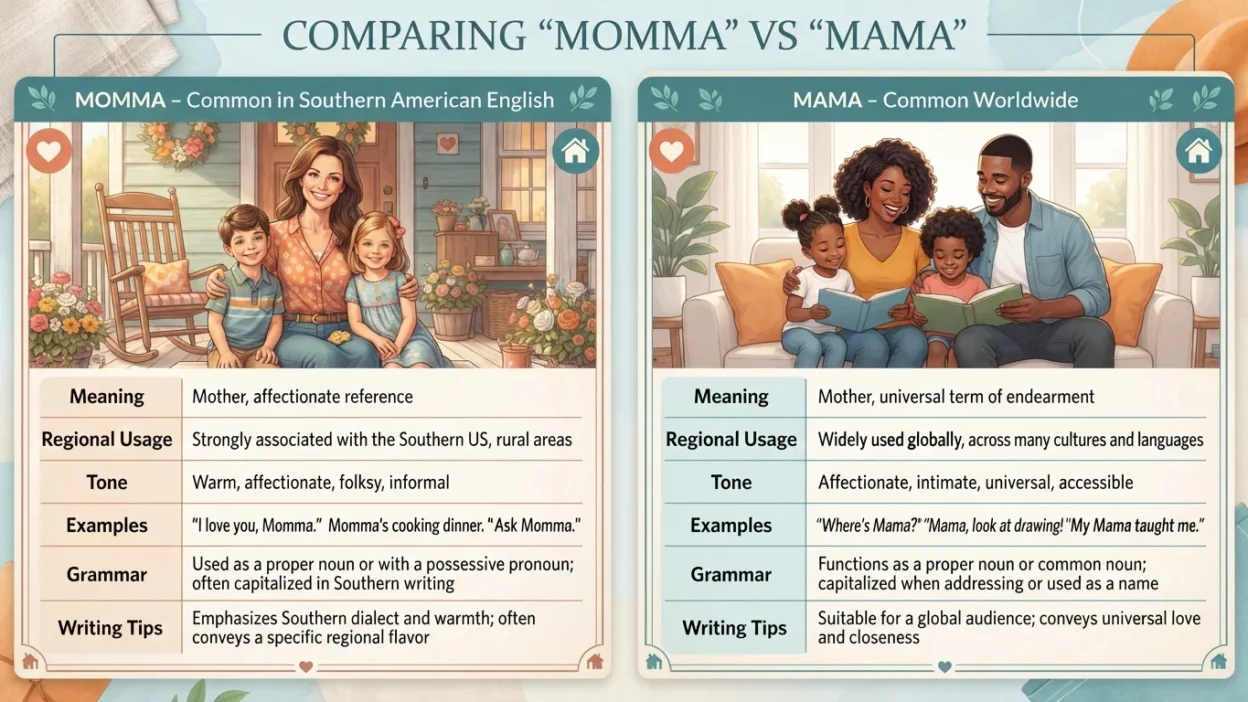
The difference between momma and mama is mostly about regional preference and personal style rather than grammar.
Mama is used in many English-speaking countries and even in dozens of other languages around the world. It is one of the earliest words many babies learn to say.
Momma, on the other hand, is especially common in parts of the United States, particularly the South. It often gives writing a warm, home-like, or country feeling.
Quick Comparison
| Feature | Mama | Momma |
|---|---|---|
| Standard English | ✅ Yes | ✅ Yes |
| Used worldwide | ✅ Very common | Less common |
| Popular in Southern US | Sometimes | ✅ Very common |
| Warm and affectionate | ✅ Yes | ✅ Yes |
| Grammatically correct | ✅ Yes | ✅ Yes |
When Should You Use “Mama”?
Use mama when you want a simple, classic, and widely recognized word.
You’ll often hear it:
- From young children
- In songs
- In books
- In conversations
- Across many countries
Example Sentences
- My mama always knows how to make me smile.
- The baby called for mama.
- I learned many life lessons from my mama.
- Everyone waited for mama to arrive.
- She thanked her mama for the support.
From my experience, mama feels natural in almost every situation because people around the world immediately understand it.
When Should You Use “Momma”?
Momma is often chosen to create a personal, emotional, or regional tone.
You’ll frequently see it in:
- Southern American speech
- Country music
- Family stories
- Personal memories
- Fictional dialogue
Writers sometimes choose momma because it feels especially loving and familiar.
Momma vs Mama Comparison
| Situation | Best Choice | Reason |
|---|---|---|
| Everyday conversation | Either | Both are widely understood. |
| Southern American English | Momma | More common in regional speech. |
| International English | Mama | Recognized across many cultures. |
| Children’s speech | Mama | Often one of a baby’s first words. |
| Storytelling with a Southern tone | Momma | Adds warmth and local flavor. |
| Personal preference | Either | Families often choose the term they naturally use. |
Why Do Both Words Exist?
Language changes over time, and family words often develop different spellings. While mama has been used for centuries and appears in many languages, momma became popular as a spelling that reflects the way many people pronounce the word, especially in parts of the United States.
Neither spelling is wrong. The choice usually depends on culture, region, family tradition, or the tone you want to create.
Common Mistakes to Avoid
People often think one spelling is correct and the other is wrong. In reality, both are acceptable when used in the right context.
Here are a few mistakes to avoid:
| Mistake | Better Choice |
|---|---|
| Thinking momma is incorrect | It is correct in many regional and informal contexts. |
| Assuming mama is only for babies | Adults commonly use mama too. |
| Mixing spellings without purpose | Stay consistent throughout your writing. |
| Ignoring your audience | Choose the spelling that best fits your readers. |
Real-Life Examples
These examples show how both words naturally fit into everyday English.
Using Mama
- Mama always encouraged me to follow my dreams.
- I called my mama after work.
- Everyone was waiting for mama at dinner.
Using Momma
- My momma baked the best apple pie.
- Momma taught me to be kind to everyone.
- I still remember the stories my momma told me before bedtime.
Does American or British English Prefer One?
Unlike many spelling differences, there is no strict American English versus British English rule for momma and mama.
American English uses both, although momma appears more often in Southern regions. British English usually uses mama when the word appears in books, conversations, or affectionate writing.
The biggest influence is personal or regional preference rather than official grammar rules.
Interesting Facts
- Mama is considered one of the earliest words spoken by babies in many languages.
- Linguists believe similar versions of mama appear across hundreds of cultures because the sound is easy for infants to make.
- Momma became especially popular through country music, family storytelling, and Southern American culture.
- Both words are associated with warmth, love, comfort, and family.
Will the Usage of Momma and Mama Change in the Future?
Both momma and mama are likely to remain common for years to come. Social media, movies, music, and family traditions continue to keep both spellings alive.
As language evolves, people may choose one spelling over the other based on personal style rather than grammar. The important thing is to stay consistent and use the version that best fits your audience and tone.
Frequently Asked Questions
Is it momma or mama?
Both momma and mama are correct. Mama is more common worldwide, while momma is especially popular in Southern American English and informal family conversations.
Which spelling is more common?
Mama is generally the more common spelling because it is widely used across many countries and languages. Momma is more regional and often appears in American culture.
Is “momma” grammatically correct?
Yes. Momma is a correct English word. It is considered an informal and affectionate way to refer to a mother and is commonly used in speech, literature, and music.
Do British English and American English use different spellings?
There is no strict grammar rule. American English commonly uses both momma and mama, while British English more often uses mama in writing.
Which should I use in my writing?
Choose mama for a more universal and widely recognized style. Use momma if you’re writing dialogue, family stories, or content with a Southern American voice.
Final Thoughts
When comparing momma or mama, there isn’t a single “right” answer. Both spellings are correct, affectionate, and widely understood. The best choice depends on your audience, writing style, regional preference, and the feeling you want your words to create. If you stay consistent throughout your writing, either option can sound natural and meaningful

Nick Mateo is a U.S.-based content writer at Aslikee who focuses on creating clear, reliable, and user-friendly content. He is passionate about delivering information that is easy to understand and genuinely helpful for readers.
He spends significant time researching topics to ensure accuracy and relevance. Nick believes that high-quality content is built on trust, transparency, and consistency, and he applies these principles in every article he works on.
At Aslikee, Nick contributes to maintaining strong editorial standards and improving the overall quality of the platform. His goal is to support users with well-structured, value-driven content that meets their needs.