Have you ever typed were when you meant where, or the other way around? These two words sound similar, but they have completely different meanings and grammar rules.
This mistake is very common because the words are close in pronunciation. However, once you understand what each word does in a sentence, choosing the correct one becomes easy.
In this guide, you’ll learn the difference between were or where, see simple examples, and discover easy tricks to remember the correct word every time.
Quick Answer
| Question | Answer |
|---|---|
| Were | Past tense form of the verb be |
| Where | Question word or adverb showing place or location |
| Are they interchangeable? | No |
| Common mistake | Using where instead of were, or vice versa |
| Best way to remember | Were = Verb, Where = Place |
What Is the Difference Between Were and Where?
The difference between were and where is simple.
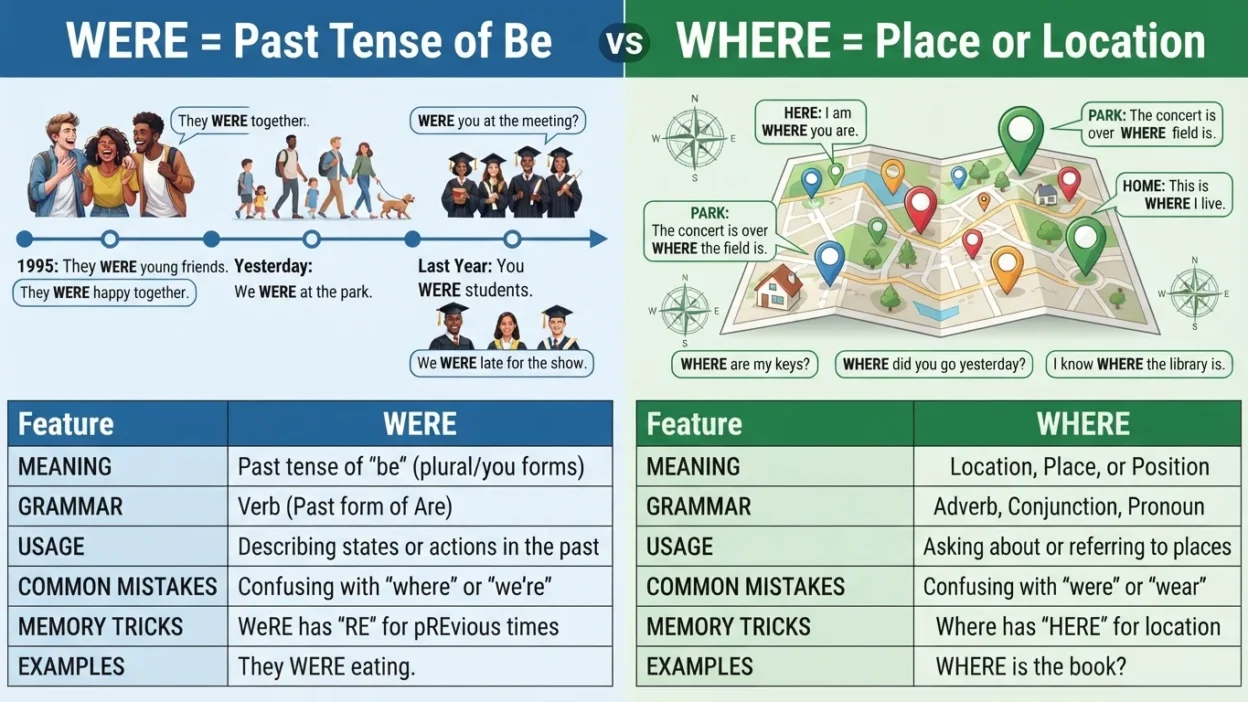
Were is a verb. It is the past tense of are and is used with plural subjects and some singular subjects in special situations.
Where is a question word or adverb. It asks about or refers to a place or location.
Although they sound alike, they perform completely different jobs in English.
Quick Comparison
| Feature | Were | Where |
|---|---|---|
| Part of speech | Verb | Adverb / Question word |
| Refers to | Past state or action | Place or location |
| Used in questions | Rarely | Very often |
| Used in statements | Yes | Yes |
| Indicates location | No | Yes |
When to Use “Were”
Use were when talking about something that happened in the past.
Examples include:
- They were happy.
- We were late.
- You were right.
- The children were excited.
- My friends were waiting outside.
Example Sentences
- We were at school yesterday.
- They were ready for the trip.
- The books were on the table.
- You were my best friend.
- The players were tired after the game.
From my experience, remembering that were is always a verb makes it much easier to avoid confusion.
When to Use “Where”
Use where whenever you’re asking about a place or describing a location.
Examples include:
- Where are you?
- Where do you live?
- I know where she works.
- This is where we met.
- Tell me where the keys are.
Example Sentences
- Where is the library?
- Do you know where my phone is?
- This is where we first met.
- Where did you buy that book?
- I forgot where I parked the car.
Were vs Where Comparison
| Situation | Use Were | Use Where |
|---|---|---|
| Talking about the past | ✅ Yes | ❌ No |
| Asking about a place | ❌ No | ✅ Yes |
| Describing a location | ❌ No | ✅ Yes |
| Past form of be | ✅ Yes | ❌ No |
| Beginning a location question | ❌ No | ✅ Yes |
Why Do People Confuse Were and Where?
The biggest reason is pronunciation. In many accents, were and where sound very similar, especially during fast conversations.
Another reason is typing quickly. Since both words are common, it’s easy to choose the wrong one without noticing. Reading your sentence one more time usually helps you catch the mistake.
Common Mistakes to Avoid
Here are some of the most common errors and their corrections.
| Incorrect | Correct |
|---|---|
| Where happy yesterday. | Were happy yesterday. |
| They where at home. | They were at home. |
| Were is your backpack? | Where is your backpack? |
| I don’t know were she lives. | I don’t know where she lives. |
| Where late for class. | Were late for class. |
Easy Memory Trick
A simple trick can help you remember the difference every time.
- Were contains “we”, which can remind you of we were—something that happened in the past.
- Where contains the word “here”, which relates to a place or location.
If your sentence is about a place, choose where. If it talks about being in the past, choose were.
Real-Life Examples
Here are a few everyday examples.
Using Were
- We were excited about the concert.
- They were waiting outside the station.
- The flowers were beautiful in spring.
Using Where
- Where is your notebook?
- Can you show me where the museum is?
- This is where my grandparents live.
Were and Where in Questions
Both words can appear in questions, but they have different purposes.
| Question | Purpose |
|---|---|
| Where are you going? | Asking about a location |
| Where did you find it? | Asking about a place |
| Were you at the meeting? | Asking about a past situation |
| Were they ready on time? | Asking about a past state |
Notice that were helps form questions about the past, while where asks for information about a place.
Will People Keep Confusing Were and Where?
Yes. Since were and where sound alike in many accents, people will probably continue mixing them up. Autocorrect also misses this mistake because both are correctly spelled words.
The good news is that once you remember were = past form of “be” and where = place or location, choosing the right word becomes much easier.
Frequently Asked Questions
Is it were or where?
It depends on your sentence. Use were as the past tense of the verb be. Use where when asking about or referring to a place.
What is the difference between were and where?
Were is a verb used for past situations or states, while where is a question word or adverb used to talk about locations.
Is “where” ever used as a verb?
No. Where is not a verb. It functions as an adverb, conjunction, or pronoun depending on the sentence, but it never replaces were.
How can I remember the difference?
Think of where as containing “here,” which relates to a place. Think of were as the past tense of be, used to describe what someone or something was in the past.
Why do people confuse were and where?
The words have similar pronunciation in many English accents. They are also common words, so people often type the wrong one by mistake.
Final Thoughts
Learning the difference between were or where is easier than it first seems. Were always relates to the past tense of the verb be, while where always relates to a place or location. Keeping this simple rule in mind will help you avoid one of the most common English writing mistakes.

Robert Parker is a U.S.-based author at Aslikee who is dedicated to producing accurate and trustworthy content for readers. He focuses on presenting information in a clear and organized way, making complex topics easier to understand.
He values thorough research and careful fact-checking to ensure every piece of content meets high quality standards. Robert believes that consistency and reliability are essential for building long-term reader trust.
At Aslikee, Robert plays an important role in supporting editorial quality and content improvement. His goal is to help users access useful, well-structured information that adds real value to their experience.