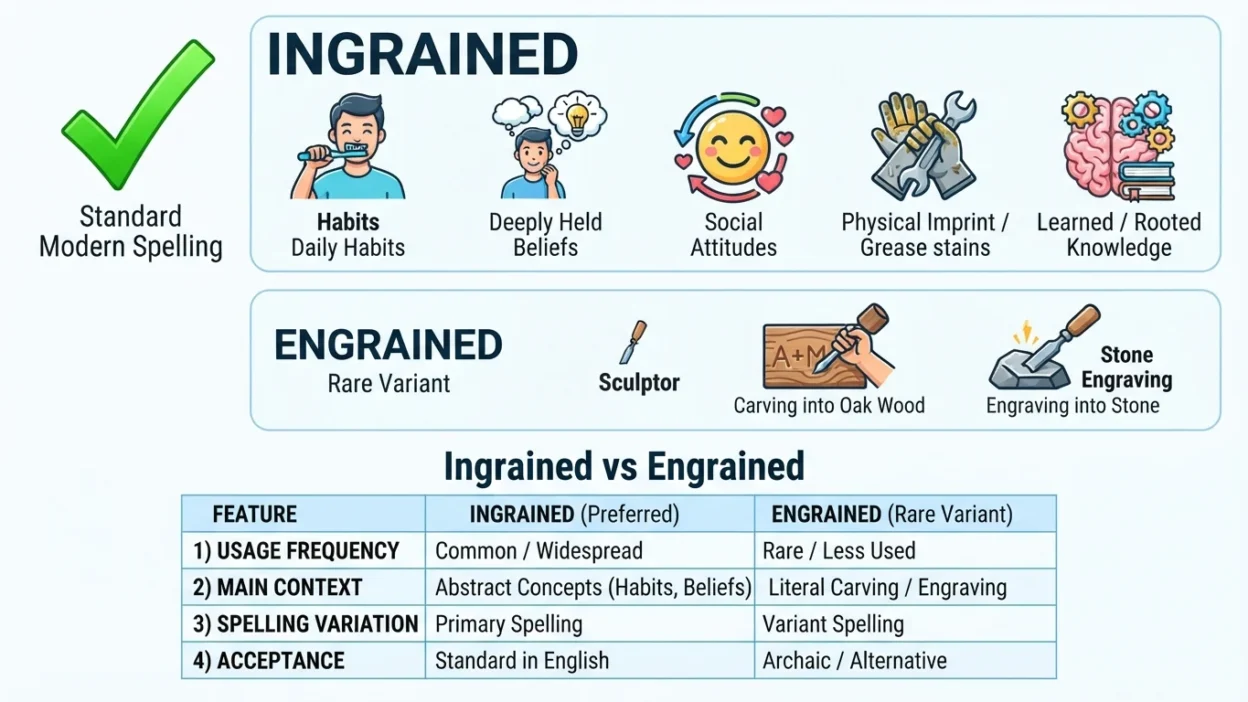
The difference between ingrained and engrained is easy to understand once you know which spelling is preferred. Always use ingrained because it is the standard spelling, widely accepted spelling, and the choice for clear writing, professional writing, and universally accepted writing. It describes something deeply established or worked into a surface, whether it is physical or intangible. From my experience, ingrained is the most common word for describing habits, deep-seated habits, beliefs, attitudes, dirt, stubborn dirt, or anything embedded in a material, such as an ingrained habit, fear of public speaking, or deeply ingrained grease on mechanic gloves.
The spelling engrained is a rare variant used in a niche sense, primarily for physical engraving, carving, or literal engraving into wood or stone. For example, a sculptor may have engrained the initials into an oak surface. Remembering this distinction makes it much easier to choose the correct spelling in everyday English.
Quick Answer
| Word | Correct? | Typical Meaning |
|---|---|---|
| Ingrained | ✅ Yes | Deeply established, firmly fixed, or embedded physically or mentally |
| Engrained | ⚠️ Rare | Usually refers to literal engraving or carving into a surface |
What Is the Difference Between Ingrained and Engrained?
Although both words share similar roots, they are not equally common today.
- Ingrained is the preferred spelling in modern English.
- Engrained is an uncommon variant that mainly appears in historical or literal references to engraving.
If you are writing for school, work, business, or everyday communication, ingrained is almost always the right choice.
What Does Ingrained Mean?
Ingrained describes something that has become deeply rooted, firmly established, or difficult to change.
It can refer to habits, beliefs, attitudes, behaviors, traditions, or even physical substances that have become embedded in a surface.
Examples
- Public speaking is an ingrained fear for many people.
- She has an ingrained habit of arriving early.
- Respect for others became an ingrained value during childhood.
- Years of practice created ingrained skills.
- The grease was ingrained in the mechanic’s gloves.
Common Uses of Ingrained
| Situation | Example |
|---|---|
| Habits | Ingrained habits are difficult to change. |
| Beliefs | Ingrained beliefs influence decisions. |
| Behavior | Ingrained behavior develops over time. |
| Dirt | Ingrained dirt is difficult to remove. |
| Skills | Ingrained skills improve through repetition. |
From my experience, ingrained is one of those words that becomes easier to remember once you associate it with something that has become deeply rooted over time rather than something carved into a surface
When to Use Engrained
The word engrained is much less common than ingrained. It is generally used in older texts or very specific contexts involving engraving, carving, or marking something into a physical surface.
Today, most professional writers choose ingrained, even when describing something deeply embedded. Unless you are discussing literal engraving, engrained is rarely the best choice.
Examples
- The sculptor engrained the initials into the oak.
- Decorative patterns were engrained into the wooden panel.
- The craftsman carefully engrained the design into the stone.
- Historic records mention symbols engrained on metal shields.
- The artist engrained fine details into the sculpture.
Common Uses of Engrained
| Situation | Example |
|---|---|
| Wood carving | The initials were engrained into the oak. |
| Stone carving | The design was engrained into the stone. |
| Sculpture | The artist engrained decorative lines. |
| Historical writing | Ancient symbols were engrained on monuments. |
| Craftsmanship | The pattern was engrained by hand. |
Ingrained vs Engrained Comparison
| Feature | Ingrained | Engrained |
|---|---|---|
| Standard modern spelling | ✅ Yes | ⚠️ Rare |
| Used in everyday English | ✅ Yes | ❌ Rare |
| Describes habits and beliefs | ✅ Yes | ❌ Usually not |
| Refers to physical engraving | Occasionally | ✅ Primarily |
| Recommended for professional writing | ✅ Yes | ❌ Usually no |
Easy Trick to Remember
A simple memory trick is:
- Ingrained → Think deeply rooted habits, beliefs, attitudes, or dirt.
- Engrained → Think engraving, carving, or cutting into wood or stone.
If you are talking about something mental, emotional, or commonly embedded over time, ingrained is almost always correct.
Common Mistakes
Many writers mistakenly use:
❌ He has an engrained habit of waking up early.
The better choice is:
✅ He has an ingrained habit of waking up early.
Another example:
❌ Respect became engrained in the culture.
The preferred spelling is:
✅ Respect became ingrained in the culture.
Real-Life Examples
| Situation | Correct Sentence |
|---|---|
| Personal habits | She has an ingrained routine. |
| Workplace | Safety practices are ingrained in the company culture. |
| Education | Reading became an ingrained habit. |
| Mechanics | The grease was ingrained into the gloves. |
| Sculpture | The artist engrained initials into the oak. |
From my experience, using ingrained for almost every modern situation is the safest choice. Reserve engrained only when you truly mean physical engraving or carving.
Why Do People Confuse Ingrained and Engrained?
People often confuse ingrained and engrained because the words look nearly identical and share a similar history. While both can suggest something worked deeply into a surface, modern English overwhelmingly favors ingrained for both literal and figurative meanings.
Today, dictionaries, style guides, and professional editors recommend ingrained in almost every situation. Seeing engrained is uncommon unless you are reading older texts or discussing literal engraving.
Practice Quiz
Choose the correct answer.
- She has an _____ habit of exercising every morning.
- ✅ ingrained
- The sculptor _____ the initials into the oak.
- ✅ engrained
- Respect became an _____ value in the family.
- ✅ ingrained
- The grease was _____ in the mechanic’s gloves.
- ✅ ingrained
- The craftsman _____ a decorative pattern into the stone.
- ✅ engrained
Quick Summary
| Situation | Correct Word |
|---|---|
| Deeply rooted habits | Ingrained |
| Beliefs and attitudes | Ingrained |
| Embedded dirt or grease | Ingrained |
| Professional and academic writing | Ingrained |
| Literal carving or engraving | Engrained (rare) |
Frequently Asked Questions
Is it ingrained or engrained?
Ingrained is the standard and widely accepted spelling in modern English. Engrained is a rare variant usually limited to literal engraving.
Is engrained a real word?
Yes. Engrained is a real but uncommon word. It is generally used for physical engraving or carving rather than everyday writing.
Can I use ingrained for habits and beliefs?
Yes. Ingrained is the correct word for describing deeply rooted habits, beliefs, attitudes, behaviors, and traditions.
When should I use engrained?
Use engrained only in rare situations involving literal engraving into materials such as wood or stone. In most cases, ingrained is the better choice.
How can I remember the difference?
Think of ingrained as deeply rooted and engrained as engraved. If you are not talking about carving into a surface, choose ingrained.
Final Thoughts
Choosing between ingrained and engrained is much easier once you know the modern preference. Ingrained is the spelling you should use for almost all everyday, academic, and professional writing, while engrained is reserved for rare references to physical engraving. Remembering this simple distinction will help make your writing more natural and accurate.

Henry James is the primary author and content creator at Aslikee. Based in the United States, he is passionate about creating informative, reliable, and easy-to-understand content for a global audience.
With a strong focus on accuracy and user value, Henry specializes in researching topics thoroughly and presenting them in a clear, practical way. His writing reflects a commitment to quality, transparency, and continuous learning, ensuring readers receive content they can trust and benefit from.
At Aslikee, Henry James plays a key role in shaping the website’s vision and maintaining high editorial standards. He believes in delivering content that is not only helpful but also engaging and accessible for users of all backgrounds.
When he’s not working on content, Henry enjoys exploring new ideas, staying up to date with digital trends, and improving the overall user experience of the platform