Many people confuse complimentary and complementary because they sound exactly the same. Even though they are pronounced alike, they have very different meanings and are used in different situations.
If you’ve ever wondered whether something is complimentary or complementary, you’re not alone. This pair is one of the most commonly confused words in English.
The good news is that once you understand what each word means, choosing the correct one becomes easy.
Quick Answer
| Word | Meaning | Example |
|---|---|---|
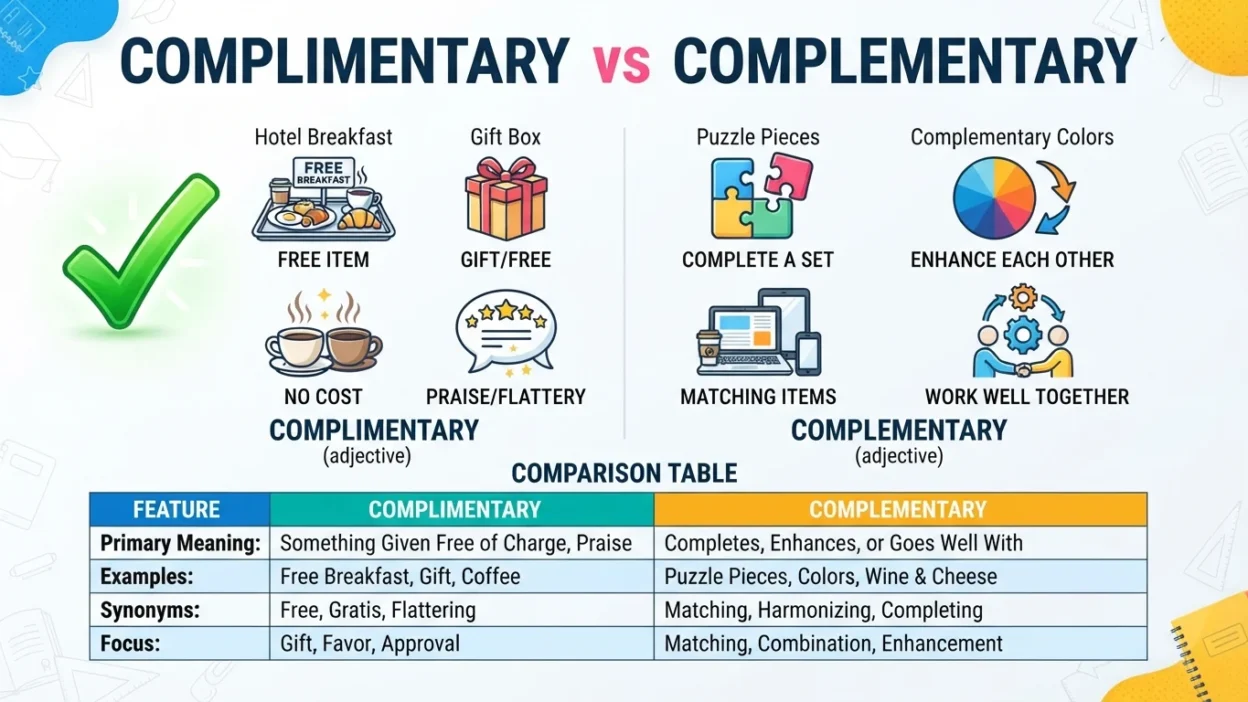
| Complimentary | Free of charge or expressing praise | The hotel offers complimentary breakfast. |
| Complementary | Completing or going well together | Their skills are complementary. |
What Is the Difference Between Complimentary and Complementary?
Although the words look and sound similar, they have completely different meanings.
- Complimentary relates to compliments, praise, or something given for free.
- Complementary comes from complement, meaning something that completes, improves, or matches something else.
Remember this simple idea:
- Complimentary = Compliment or Free
- Complementary = Complete or Match
When to Use Complimentary
Use complimentary when talking about praise, admiration, positive remarks, or something provided at no cost.
It is commonly used in hotels, restaurants, airlines, businesses, and customer service.
Examples
- The hotel provides complimentary breakfast.
- Guests received complimentary drinks.
- She made several complimentary comments about the presentation.
- The airline offered complimentary snacks.
- Customers enjoyed a complimentary gift.
Common Uses of Complimentary
| Situation | Example |
|---|---|
| Hotels | Complimentary breakfast |
| Restaurants | Complimentary dessert |
| Airlines | Complimentary beverages |
| Business | Complimentary gifts |
| Conversations | Complimentary remarks |
From my experience, most people encounter complimentary when something is free, making that meaning the easiest one to remember.
When to Use Complementary
Use complementary when two or more things complete, enhance, or work well together. The word comes from complement, not compliment.
It is commonly used in business, design, education, fashion, healthcare, and relationships to describe things that fit together naturally.
Examples
- Their skills are complementary.
- The blue curtains are complementary to the white walls.
- These software tools are complementary products.
- The two teams have complementary strengths.
- Healthy eating and exercise are complementary habits.
Common Uses of Complementary
| Situation | Example |
|---|---|
| Business | Complementary products increase sales. |
| Design | Complementary colors create balance. |
| Education | Complementary teaching methods improve learning. |
| Healthcare | Diet and exercise are complementary. |
| Relationships | Their personalities are complementary. |
Complimentary vs Complementary Comparison
| Feature | Complimentary | Complementary |
|---|---|---|
| Main Meaning | Free or expressing praise | Completing or matching |
| Related Word | Compliment | Complement |
| Common in Hospitality | ✅ Yes | ❌ Rare |
| Common in Design | ❌ Rare | ✅ Yes |
| Common in Business | Free gifts or services | Products that work together |
Easy Trick to Remember
A simple memory trick is:
- Complimentary contains compliment → Think praise or free gifts.
- Complementary contains complement → Think complete or match.
Ask yourself:
- Is it free or praising someone? → Use complimentary.
- Does it complete or improve something else? → Use complementary.
Common Mistakes
Many people write:
❌ The hotel offers complementary breakfast.
The correct sentence is:
✅ The hotel offers complimentary breakfast.
Another common mistake is:
❌ Their personalities are complimentary.
The correct sentence is:
✅ Their personalities are complementary.
The confusion happens because both words sound identical, but their meanings are completely different.
Real-Life Examples
| Situation | Correct Sentence |
|---|---|
| Hotel | Guests receive complimentary breakfast. |
| Airline | Complimentary drinks are included. |
| Office | She received complimentary feedback. |
| Fashion | The colors are complementary. |
| Business | The products are complementary and sell well together. |
From my experience, remembering free = complimentary and matching = complementary makes it much easier to choose the correct word.
Why Do People Confuse Complimentary and Complementary?
People often confuse complimentary and complementary because they are pronounced the same and differ by only a few letters. However, they come from different root words and have different meanings.
A simple way to avoid mistakes is to connect complimentary with compliment (praise or free) and complementary with complement (complete or match).
Practice Quiz
Choose the correct answer.
- The hotel offers _____ breakfast.
- ✅ complimentary
- Their personalities are _____.
- ✅ complementary
- Guests received _____ drinks during the flight.
- ✅ complimentary
- These two software programs are _____.
- ✅ complementary
- The manager made several _____ remarks about the team’s work.
- ✅ complimentary
Quick Summary
| Situation | Correct Word |
|---|---|
| Free service or product | Complimentary |
| Praise or positive remarks | Complimentary |
| Things that complete each other | Complementary |
| Matching colors or designs | Complementary |
| Products that work well together | Complementary |
Frequently Asked Questions
Is it complimentary or complementary breakfast?
The correct phrase is complimentary breakfast because the meal is provided free of charge.
What does complementary mean?
Complementary means two or more things complete, improve, or work well with each other.
What does complimentary mean?
Complimentary means expressing praise or providing something free, such as complimentary tickets, drinks, or breakfast.
Can something be both complimentary and complementary?
Yes. For example, a free software tool is complimentary, while it may also be complementary if it works well with another program.
How can I remember the difference?
Use this easy trick:
- Complimentary = Compliment = Praise or Free
- Complementary = Complement = Complete or Match
Final Thoughts
Knowing the difference between complimentary and complementary helps you avoid one of the most common vocabulary mistakes in English. Use complimentary for praise or free items, and choose complementary when talking about things that complete or enhance each other. Once you remember the connection to compliment and complement, selecting the correct word becomes much easier.

Robert Parker is a U.S.-based author at Aslikee who is dedicated to producing accurate and trustworthy content for readers. He focuses on presenting information in a clear and organized way, making complex topics easier to understand.
He values thorough research and careful fact-checking to ensure every piece of content meets high quality standards. Robert believes that consistency and reliability are essential for building long-term reader trust.
At Aslikee, Robert plays an important role in supporting editorial quality and content improvement. His goal is to help users access useful, well-structured information that adds real value to their experience.