When learning fiancee or fiance, knowing the difference between fiancé and fiancée is simple because it depends on person’s gender, French grammar, and spelling.
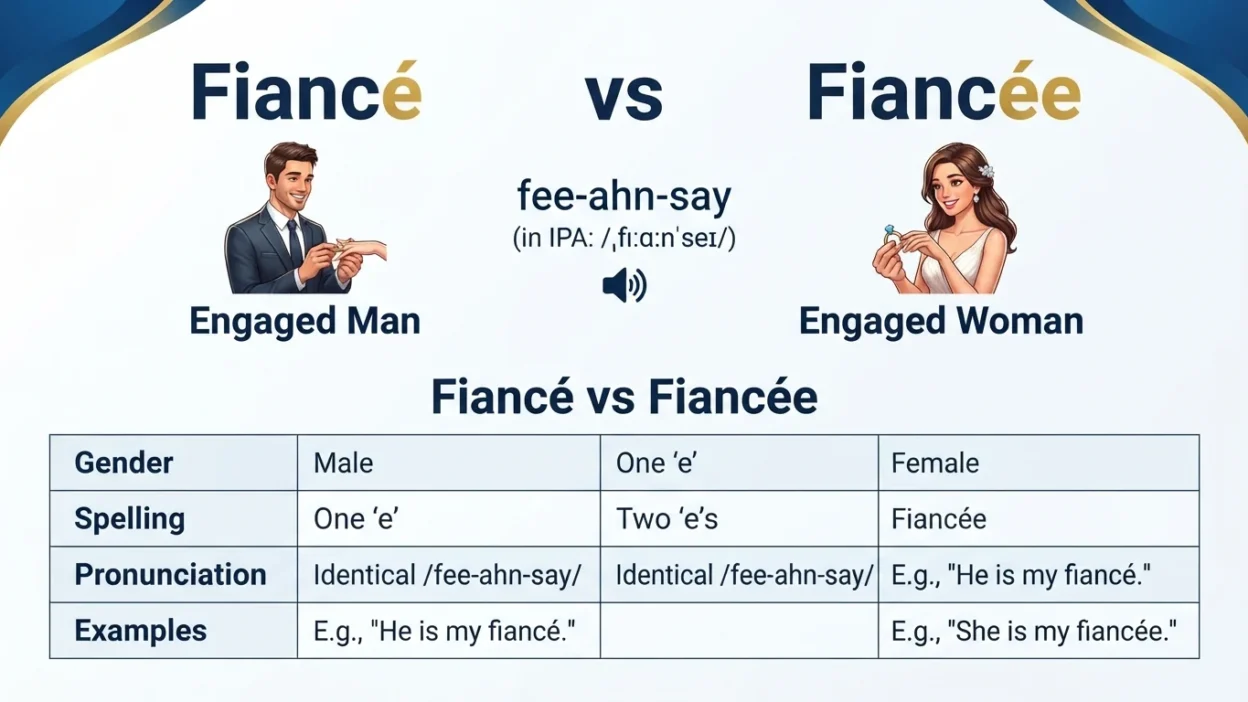
A fiancé with one “e” is a man, while a fiancée with two “e”s is a woman. Both are pronounced exactly the same as fee-ahn-say, but the extra “e” marks the feminine form. From my experience, this simple spelling rule helps you choose the correct word every time.
A useful example is he is my fiancé when talking about a man and she is my fiancée when referring to a woman. Although they sound identical, paying attention to the word ending helps you write correctly in both formal English and everyday English.
Quick Answer
| Word | Refers To | Correct Usage |
|---|---|---|
| Fiancé | A man who is engaged | ✅ Correct |
| Fiancée | A woman who is engaged | ✅ Correct |
What Is the Difference Between Fiance and Fiancee?
The difference between fiancé and fiancée depends on gender.
- Fiancé (one e) refers to a man.
- Fiancée (two e’s) refers to a woman.
Although both words are pronounced the same—fee-ahn-say—their spellings identify whether you are talking about a male or female partner.
Why Are the Spellings Different?
These words come from the French language.
French often changes word endings based on gender. The extra e in fiancée marks the feminine form, while fiancé remains the masculine form.
English borrowed both spellings, so the distinction is still used today.
Quick Comparison
| Feature | Fiancé | Fiancée |
|---|---|---|
| Gender | Male | Female |
| Number of “e”s | One | Two |
| Pronunciation | Fee-ahn-say | Fee-ahn-say |
| Modern English | Standard | Standard |
Examples of Fiancé
Here are a few examples using fiancé correctly.
- My fiancé proposed during our vacation.
- She introduced everyone to her fiancé.
- Her fiancé loves hiking.
- My sister’s fiancé is a doctor.
- We invited my cousin and her fiancé to dinner.
From my experience, the easiest trick is to remember that the shorter spelling usually refers to the man.
Examples of Fiancée
Use fiancée when referring to an engaged woman.
- My fiancée enjoys cooking.
- He surprised his fiancée with flowers.
- His fiancée planned the celebration.
- Everyone welcomed his fiancée warmly.
- My brother’s fiancée is a talented artist.
Easy Trick to Remember the Difference
A simple memory trick can save you from making this mistake.
- Fiancé → One “e” → Man
- Fiancée → Two “e’s” → Woman
Another helpful tip is to think of the extra e as representing the feminine ending that comes from French grammar.
Common Mistakes People Make
Many writers accidentally use the wrong spelling because both words sound exactly the same.
Incorrect:
- ❌ My fiancée is a wonderful husband.
- ❌ Her fiancé is getting ready for the bridal shower.
Correct:
- ✅ My fiancé is a wonderful husband.
- ✅ Her fiancée is getting ready for the bridal shower.
Always match the spelling to the person’s gender rather than the pronunciation.
Do You Need the Accent Mark?
Technically, the correct spellings are fiancé and fiancée, both with an accent on the “e.”
However, many English speakers type:
- fiance
- fiancee
without accents, especially on phones and keyboards.
Both forms are widely understood, but using the accented versions is considered more accurate in formal writing.
Real-Life Examples
| Situation | Correct Word |
|---|---|
| Engaged man | Fiancé |
| Engaged woman | Fiancée |
| Wedding invitation | Depends on the person’s gender |
| Engagement announcement | Depends on the person’s gender |
| Formal writing | Prefer fiancé and fiancée |
Why This Confusion Happens
This is one of the most common spelling questions because English rarely changes words based on gender anymore.
Since both words have identical pronunciation, people often rely on sound instead of spelling, which leads to confusion.
Fortunately, once you know the simple French rule, the choice becomes easy.
Related Words
Understanding related wedding vocabulary also helps.
| Word | Meaning |
|---|---|
| Engagement | Promise to marry |
| Bride | Woman getting married |
| Groom | Man getting married |
| Spouse | Husband or wife |
| Marriage | Legal union between two people |
| Wedding | Marriage ceremony |
Many dictionaries and style guides continue to recommend keeping the distinction between fiancé and fiancée, especially in formal writing and published content.
Frequently Asked Questions
Is it fiancé or fiancée for a man?
Use fiancé for a man. It has one “e” and refers to an engaged male partner.
Is fiancée used for a woman?
Yes. Fiancée has two “e’s” and refers to an engaged woman. The extra e marks the feminine form.
Are fiancé and fiancée pronounced differently?
No. Both words are pronounced the same way: fee-ahn-say. The difference is only in spelling and gender.
Can I write fiance or fiancee without accents?
Yes. Many people write fiance and fiancee without accent marks, especially online. However, fiancé and fiancée are the preferred spellings in formal writing.
How can I remember the difference?
Think of this simple rule:
- Fiancé = one e = man
- Fiancée = two e’s = woman
This memory trick works well because the extra e represents the feminine ending.
Final Thoughts
Choosing between fiancee or fiance is easier than it first appears. Both words share the same pronunciation, but their spellings indicate gender. Use fiancé for an engaged man and fiancée for an engaged woman. Once you remember the “one e for a man, two e’s for a woman” rule, you’ll rarely make this mistake again, whether you’re writing an email, wedding invitation, engagement announcement, or social media post.

Nick Mateo is a U.S.-based content writer at Aslikee who focuses on creating clear, reliable, and user-friendly content. He is passionate about delivering information that is easy to understand and genuinely helpful for readers.
He spends significant time researching topics to ensure accuracy and relevance. Nick believes that high-quality content is built on trust, transparency, and consistency, and he applies these principles in every article he works on.
At Aslikee, Nick contributes to maintaining strong editorial standards and improving the overall quality of the platform. His goal is to support users with well-structured, value-driven content that meets their needs.