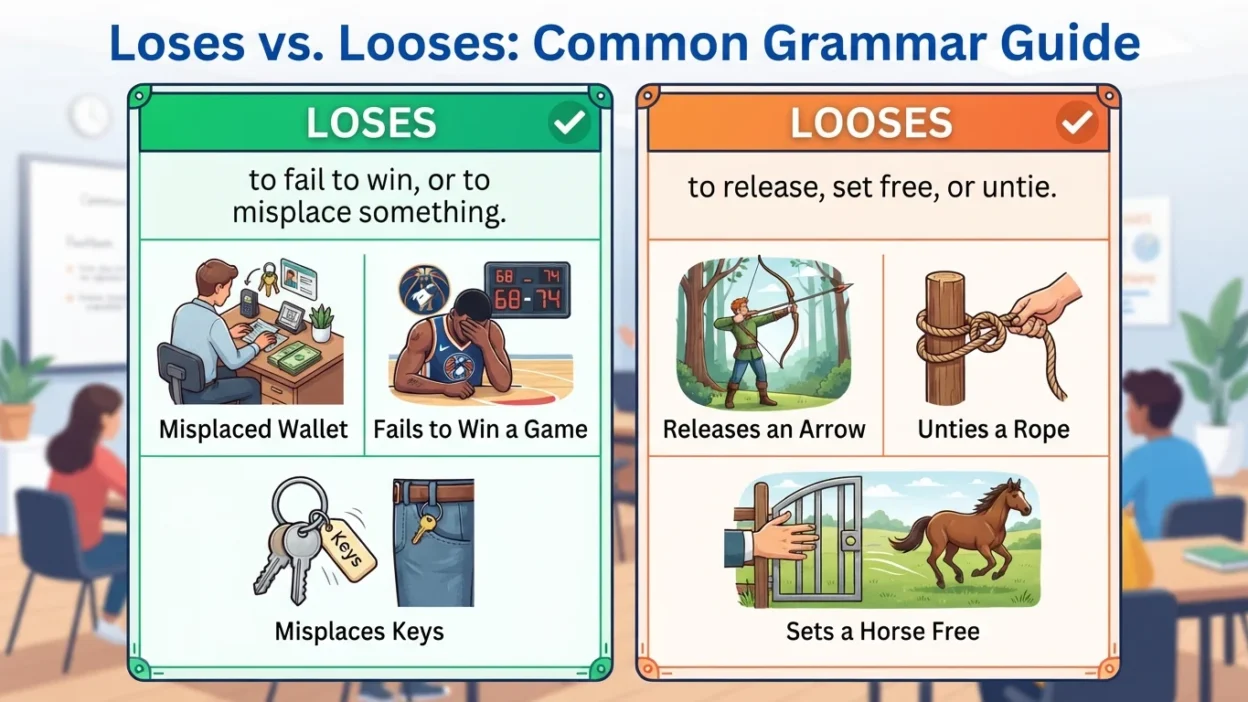
Learning loses or looses is much easier when you understand how lose and loose differ in meaning, spelling, and pronunciation every day. The key differences become clear at a glance once you understand their meanings and pronunciation. Use lose with one o as a verb for misplacing something, failing to win, or describing an action involving deprivation, misplacement, an object, an opportunity, or a game. It is pronounced /luːz/ with a z sound. From my experience, examples such as lose my keys and lose the match make the rule easy to remember.
Use loose with two o’s as an adjective or descriptive adjective for something not tight or securely fastened. It is pronounced /luːs/ with a soft s sound and often describes things that are slack, baggy, or untied. You might say your pants are too loose or that a horse broke loose. These examples make the difference easier to understand in everyday English.
Quick Answer
| Word | Meaning | Example |
|---|---|---|
| Loses | Third-person singular form of lose, meaning fails to win or misplaces something | She loses her keys often. |
| Looses | Third-person singular form of loose, meaning releases or sets free | He looses the dogs from the yard. (Rare usage) |
What Is the Difference Between Loses and Looses?
The difference comes from two different base words.
- Loses comes from the verb lose, which means to misplace something or fail to win.
- Looses comes from the verb loose, meaning to release, let go, or set free. This form is much less common in modern English.
Most of the time, people accidentally write looses when they actually mean loses.
What Does Loses Mean?
Loses is the present tense form of lose used with singular subjects like he, she, or it.
It describes someone failing to keep something, missing an opportunity, or not winning a competition.
Examples
- She loses her phone all the time.
- He loses every chess match.
- The company loses money during slow seasons.
- My brother loses his homework frequently.
- The team loses another close game.
Common Situations Where Loses Is Used
| Situation | Example |
|---|---|
| Misplacing items | She loses her keys. |
| Sports | The team loses the match. |
| Business | The company loses customers. |
| Games | He loses every round. |
| Opportunities | She loses a great chance. |
From my experience, loses is one of the most commonly used verb forms in everyday English, while looses appears only in very specific contexts.
When to Use Looses
The word looses is much less common than loses. It comes from the verb loose, which means to release, untie, or set free.
You will mostly find looses in historical writing, literature, or discussions about archery, hunting, or animals. In everyday English, people rarely use it.
Examples
- The archer looses an arrow toward the target.
- He looses the horse from the stable.
- The farmer looses the sheep into the field.
- She looses the rope holding the boat.
- The trainer looses the birds after the event.
Common Situations Where Looses Is Correct
| Situation | Example |
|---|---|
| Archery | The archer looses an arrow. |
| Animals | He looses the dogs into the yard. |
| Boating | She looses the rope. |
| Farming | The farmer looses the cattle. |
| Literature | The knight looses his horse. |
Loses vs Looses Comparison
| Feature | Loses | Looses |
|---|---|---|
| Base word | Lose | Loose |
| Meaning | Fails to win or misplaces | Releases or sets free |
| Common in everyday English | ✅ Very common | ❌ Rare |
| Used in modern conversation | ✅ Yes | Rarely |
| Common mistake | ❌ No | ✅ Often used by mistake |
Easy Trick to Remember
A simple memory trick is:
- Lose → Loses = Fails or misplaces
- Loose → Looses = Releases or sets free
Ask yourself:
Did someone fail to win or misplace something? → Use loses.
Did someone release or untie something? → Use looses.
Common Mistakes
Many writers accidentally type:
❌ She looses her wallet every week.
The correct sentence is:
✅ She loses her wallet every week.
Another common mistake is:
❌ Our team always looses the game.
The correct sentence is:
✅ Our team always loses the game.
Spell-check may not catch this error because looses is a real word—it just has a different meaning.
Real-Life Examples
| Situation | Correct Sentence |
|---|---|
| School | He loses his notebook often. |
| Sports | The team loses another match. |
| Home | She loses her glasses regularly. |
| Archery | The hunter looses an arrow. |
| Farm | The farmer looses the horses into the field. |
From my experience, remembering that loses is used for everyday situations while looses means releases makes the difference much easier to remember.
Why Do People Confuse Loses and Looses?
Many people confuse loses and looses because they differ by only one extra “o.” Since both are real English words, spell-checkers may not flag the mistake, making it even easier to overlook.
The simplest way to avoid confusion is to remember that loses relates to losing, while looses relates to loosening or releasing something.
Practice Quiz
Choose the correct answer.
- She _____ her keys almost every week.
- ✅ loses
- The archer _____ an arrow toward the target.
- ✅ looses
- Our team usually _____ close games.
- ✅ loses
- The farmer _____ the horses into the field.
- ✅ looses
- He _____ his phone whenever he travels.
- ✅ loses
Quick Summary
| Situation | Correct Word |
|---|---|
| Fails to win | Loses |
| Misplaces something | Loses |
| Releases or sets free | Looses |
| Unties or loosens | Looses |
| Everyday English | Loses (most common) |
| Historical or literary use | Looses |
Frequently Asked Questions
Is it loses or looses?
It depends on the meaning. Loses means fails to win or misplaces something. Looses means releases or sets free and is much less common.
Why do people write “looses” instead of “loses”?
The words look very similar, and the extra “o” is easy to add by mistake. Since looses is a real word, spelling tools may not always catch the error.
Is looses a real word?
Yes. Looses is the third-person singular form of loose as a verb, meaning to release, untie, or set free. It is correct only in those contexts.
What is the difference between lose and loose?
Lose is a verb meaning to misplace or to fail to win. Loose is usually an adjective meaning not tight, but it can also be a verb meaning to release.
How can I remember the difference?
Use this simple trick:
- Loses = Losing
- Looses = Loosening or Releasing
If someone is failing to win or misplacing something, loses is almost always the correct choice.
Final Thoughts
Understanding the difference between loses and looses is easier than it first appears. In everyday writing, you’ll almost always need loses. Reserve looses for the rare situations where someone releases or sets something free. Keeping this simple rule in mind will help you write with greater accuracy and confidence.

William Cooper is a U.S.-based content writer at Aslikee who focuses on creating clear, informative, and user-friendly content. He is committed to delivering information that is accurate, practical, and easy for readers to understand.
He believes that strong content comes from careful research and attention to detail. William takes time to ensure that each article meets quality standards and provides real value to users.
At Aslikee, William contributes to maintaining editorial consistency and improving content quality. His goal is to support readers with reliable information and help build long-term trust in the platform.