Have you ever paused while typing because you weren’t sure whether to write received or recieved? You’re not alone. This is one of the most common English spelling mistakes because the letters i and e are easy to mix up.
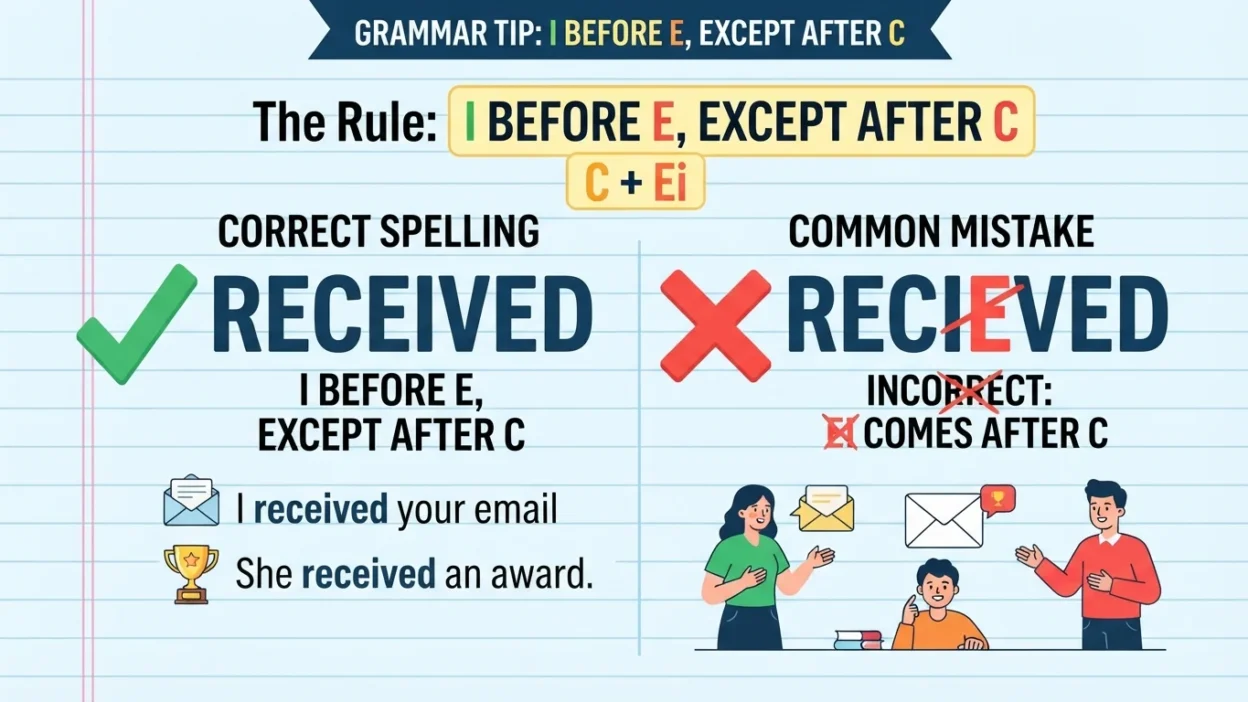
The correct spelling is received. The word recieved is always incorrect and should not be used in formal or informal writing.
This guide explains the correct spelling, why people confuse the two words, easy memory tricks, and plenty of examples to help you remember it for good.
Quick Answer
| Word | Correct? | Meaning |
|---|---|---|
| Received | ✅ Yes | Got, accepted, or was given something |
| Recieved | ❌ No | Incorrect spelling |
What Is the Difference Between Received and Recieved?
There is only one correct spelling:
- Received ✅
- Recieved ❌
The confusion comes from the position of the letters i and e.
The correct order is ei, not ie.
Why Is “Received” Correct?
The verb receive follows the well-known spelling pattern:
“I before E, except after C.”
Since the letter c comes before ei, the correct spelling becomes:
- receive
- received
- receiving
- receiver
Although English has exceptions to this rule, received follows it perfectly.
What Does Received Mean?
Received is the past tense and past participle of receive.
It means to get, accept, collect, or be given something.
Example Sentences
- I received your email this morning.
- She received a scholarship.
- They received excellent customer service.
- We received the package yesterday.
- He received an award for his work.
Why Do People Misspell It?
Most people accidentally write recieved because the letters i and e sound similar when spoken.
Fast typing, autocorrect errors, and memory mistakes also contribute to this common spelling error.
Easy Memory Trick
Remember this famous spelling rule:
I before E, except after C.
Since receive has the letter C, the correct spelling is:
- receive
- received
Just remember:
- C + EI = Received ✅
- IE after C = Wrong ❌
This simple trick helps most learners remember the correct spelling.
How to Use “Received” Correctly
The word received is used when someone gets, accepts, or is given something. It is the correct past tense and past participle of receive.
You can use it in everyday conversations, emails, school assignments, business writing, and formal documents.
Common Examples
| Situation | Correct Usage |
|---|---|
| received an email | |
| Package | received a package |
| Award | received an award |
| Gift | received a gift |
| Letter | received a letter |
| Payment | received payment |
| Scholarship | received a scholarship |
| Message | received a message |
Example Sentences
- I received your message yesterday.
- She received a beautiful birthday gift.
- We received the order on time.
- He received positive feedback from his manager.
- They received an invitation to the event.
Why “Recieved” Is Incorrect
Recieved is simply a misspelling. It does not appear as a correct word in standard English dictionaries.
Many people reverse the letters i and e, but the correct spelling is always received.
Incorrect vs Correct
| Incorrect | Correct |
|---|---|
| I recieved your email. | I received your email. |
| She recieved an award. | She received an award. |
| We recieved the package. | We received the package. |
| He recieved good news. | He received good news. |
Received vs Recieved Comparison
| Feature | Received | Recieved |
|---|---|---|
| Correct English spelling | ✅ Yes | ❌ No |
| Found in dictionaries | ✅ Yes | ❌ No |
| Suitable for formal writing | ✅ Yes | ❌ No |
| Suitable for exams | ✅ Yes | ❌ No |
| Should you use it? | ✅ Always | ❌ Never |
Real-Life Example
Imagine you ordered a new phone online. When the delivery arrives, you would say, “I received my package today.” Writing “I recieved my package today” would be considered a spelling mistake.
Similarly, after checking your inbox, you might write, “I received your email this morning.” This is the correct spelling in both personal and professional communication.
Tips to Remember the Correct Spelling
These quick tricks can help you avoid this common mistake:
- Remember “I before E, except after C.”
- Receive comes after the letter C, so use EI.
- Think of the pattern: receive, received, receiver, receiving.
- If you’re unsure, use your spell checker or dictionary.
- Practice writing the correct spelling a few times to build the habit.
Once you remember C + EI, you’ll rarely misspell received again.
Frequently Asked Questions
Is it received or recieved?
The correct spelling is received. Recieved is a spelling mistake and should not be used in any type of writing.
Why is “received” spelled with “ei”?
Received follows the common spelling rule: “I before E, except after C.” Because the word contains the letter C, the correct letter order is EI.
Is “recieved” in the dictionary?
No. Standard English dictionaries list received as the correct spelling. Recieved is not recognized as a correct English word.
How can I remember the spelling of received?
A simple trick is to remember “C comes before EI.” Think of the phrase “I before E, except after C” whenever you write receive or received.
Is “received” the past tense of “receive”?
Yes. Received is both the past tense and the past participle of the verb receive.
Quick Practice Quiz
Choose the correct spelling.
- I _____ your email yesterday.
- ✅ received
- She _____ a scholarship.
- ✅ received
- We _____ the package this morning.
- ✅ received
- He _____ excellent news from the company.
- ✅ received
- They _____ their certificates after the ceremony.
- ✅ received
Key Takeaways
| Situation | Correct Spelling |
|---|---|
| Past tense of receive | Received |
| Past participle of receive | Received |
| Email confirmation | Received |
| Package delivery | Received |
| Common misspelling | Recieved ❌ |
Final Thoughts
The choice between received and recieved is simple because only one spelling is correct. Always write received when talking about getting, accepting, or being given something. Remember the rule “I before E, except after C,” and you’ll avoid this common spelling mistake with confidence.

Robert Parker is a U.S.-based author at Aslikee who is dedicated to producing accurate and trustworthy content for readers. He focuses on presenting information in a clear and organized way, making complex topics easier to understand.
He values thorough research and careful fact-checking to ensure every piece of content meets high quality standards. Robert believes that consistency and reliability are essential for building long-term reader trust.
At Aslikee, Robert plays an important role in supporting editorial quality and content improvement. His goal is to help users access useful, well-structured information that adds real value to their experience.