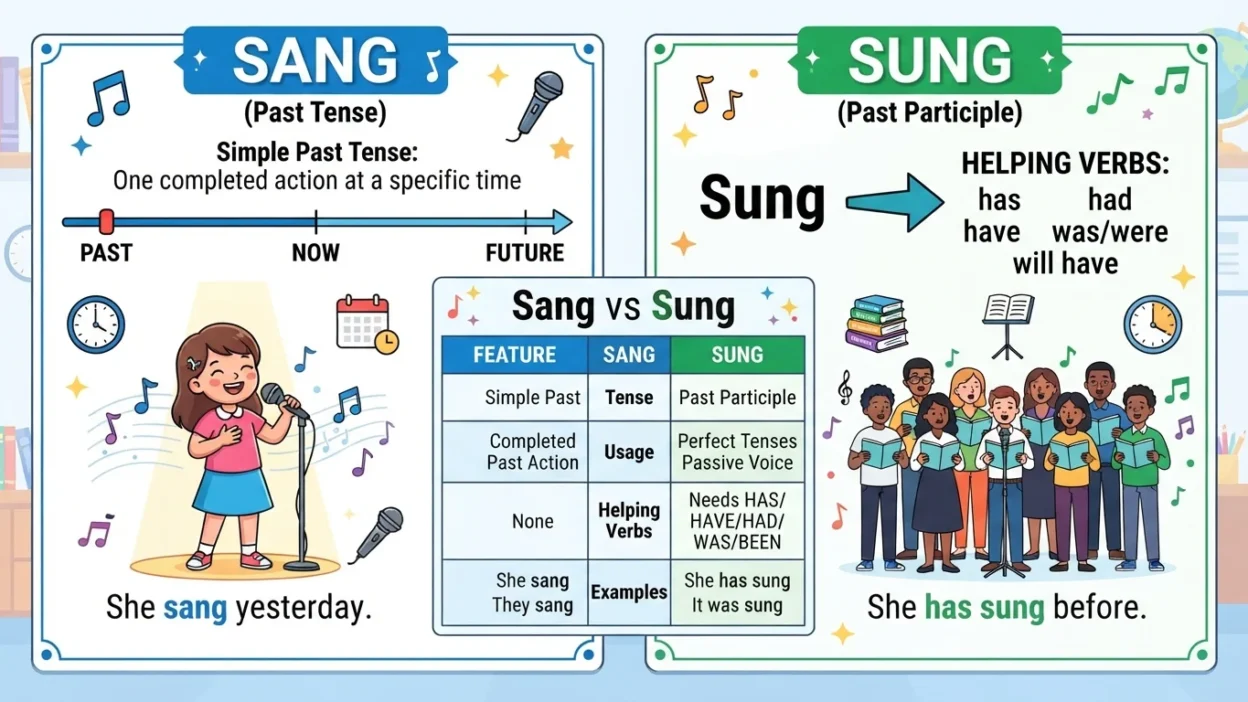
Learning sang or sung is much easier when you understand how verb tense and sentence structure work in everyday English writing and speaking. The difference is simple: use sang for the simple past tense to describe a completed action that happened at a specific time in the past. For example, she sang a song, we sang in the choir yesterday, and he sang the national anthem perfectly. From my experience, remembering that sang stands alone helps you choose the correct form every time.
Use sung as the past participle because it requires helping verb and is never on its own. It must be paired with an auxiliary verb like has, have, had, or was to form perfect tenses or the passive voice. For example, they have sung that tune many times, or the chorus was sung by the entire group. Following this rule helps prevent common grammar mistakes.
Quick Answer
| Word | When to Use | Example |
|---|---|---|
| Sang | Simple past tense | She sang beautifully yesterday. |
| Sung | Past participle with a helping verb | She has sung that song before. |
What Is the Difference Between Sang and Sung?
The difference between sang and sung comes down to verb tense.
- Sang is the simple past tense of the verb sing.
- Sung is the past participle, which must be used with a helping verb.
Many people accidentally mix them up because both refer to actions in the past, but they are not interchangeable.
Sang vs Sung at a Glance
| Feature | Sang | Sung |
|---|---|---|
| Verb Form | Simple past | Past participle |
| Needs helping verb | ❌ No | ✅ Yes |
| Used alone | ✅ Yes | ❌ No |
| Formal English | ✅ Yes | ✅ Yes |
| Example | We sang yesterday. | We have sung before. |
When to Use Sang
Use sang when describing a completed action that happened at a specific time in the past.
It stands on its own and does not require words like has, have, or had.
Examples
- She sang at the concert last night.
- We sang together in the school choir.
- He sang the national anthem perfectly.
- They sang during the ceremony.
- I sang my favorite song yesterday.
Notice that every sentence refers to a completed action in the past.
Common Situations Where Sang Is Correct
| Situation | Example |
|---|---|
| Yesterday | I sang yesterday. |
| Last week | She sang last week. |
| Last year | They sang at the festival. |
| Specific event | He sang at the wedding. |
| Past action | We sang before dinner. |
Using sang is often easy because you simply describe something that already happened.
When to Use Sung
Use sung as the past participle. Unlike sang, it cannot stand alone. It must always be used with a helping verb such as has, have, had, was, were, is, are, or been.
If you remove the helping verb, the sentence becomes grammatically incorrect.
Examples
- She has sung that song many times.
- They have sung together since childhood.
- The anthem was sung before the match.
- The song had sung its final verse before the lights went out. (Less common structure, but grammatically possible in context.)
- Every hymn has been sung beautifully.
Common Situations Where Sung Is Correct
| Situation | Example |
|---|---|
| Present perfect | She has sung before. |
| Past perfect | They had sung already. |
| Passive voice | The song was sung by the choir. |
| Present perfect continuous context | The songs have been sung for years. |
| Formal writing | The national anthem was sung perfectly. |
Sang vs Sung Comparison
| Feature | Sang | Sung |
|---|---|---|
| Tense | Simple past | Past participle |
| Needs helping verb | No | Yes |
| Used alone | Yes | No |
| Passive voice | No | Yes |
| Perfect tenses | No | Yes |
Easy Trick to Remember
A simple memory trick is:
- If there is no helping verb, use sang.
- If you see has, have, had, was, were, or been, use sung.
This rule works in almost every situation and is one of the easiest grammar tips to remember.
Common Mistakes
Many English learners accidentally say:
❌ She sung yesterday.
The correct sentence is:
✅ She sang yesterday.
Another common mistake is:
❌ I have sang this song before.
The correct version is:
✅ I have sung this song before.
These errors are common in everyday conversation, but standard English grammar clearly separates the two forms.
Real-Life Examples
Here are a few examples you may hear in daily life:
| Situation | Correct Sentence |
|---|---|
| School performance | The students sang beautifully. |
| Church service | The choir has sung this hymn for years. |
| Sports event | He sang the national anthem before the game. |
| Music competition | The winning song was sung by a young artist. |
| Family gathering | We sang together after dinner. |
From my experience, practicing with real sentences helps this grammar rule become natural very quickly.
Why Do People Confuse Sang and Sung?
One reason people confuse sang and sung is that both words come from the verb sing and both refer to actions in the past. In some regional dialects, especially in casual speech, you may hear sung used where sang should be. However, standard English grammar keeps these forms separate.
Another reason is that many irregular verbs change forms in different tenses. Once you remember that sang is the simple past and sung is the past participle, choosing the correct word becomes much easier.
Practice Quiz
Choose the correct answer.
- She _____ at the school concert yesterday.
- ✅ sang
- They have _____ this song many times.
- ✅ sung
- The national anthem was _____ before the game.
- ✅ sung
- We _____ together during the festival.
- ✅ sang
- He had _____ in the choir for several years.
- ✅ sung
Quick Summary
| Situation | Correct Word |
|---|---|
| Simple past tense | Sang |
| Past participle | Sung |
| Needs a helping verb | Sung |
| Used by itself | Sang |
| Present perfect tense | Sung |
| Past perfect tense | Sung |
| Passive voice | Sung |
Frequently Asked Questions
Is it sang or sung yesterday?
Use sang. The word yesterday indicates a simple past action, so no helping verb is needed.
Is “I have sang” correct?
No. The correct sentence is I have sung because the present perfect tense requires the past participle.
Why does sung need a helping verb?
Sung is a past participle, and past participles cannot normally stand alone. They work with helping verbs like has, have, had, or was.
Can sang be used with has or have?
No. After has, have, or had, you should always use sung, not sang.
How can I remember the difference?
Think of this simple rule: Sang stands alone. Sung needs a helper. If you see a helping verb, choose sung.
Final Thoughts
The difference between sang and sung is one of the easiest grammar rules to master once you understand verb tenses. Use sang for completed past actions without a helping verb, and use sung whenever a helping verb is present. With a little practice, you’ll use both words naturally and confidently in everyday writing and conversation.

Robert Parker is a U.S.-based author at Aslikee who is dedicated to producing accurate and trustworthy content for readers. He focuses on presenting information in a clear and organized way, making complex topics easier to understand.
He values thorough research and careful fact-checking to ensure every piece of content meets high quality standards. Robert believes that consistency and reliability are essential for building long-term reader trust.
At Aslikee, Robert plays an important role in supporting editorial quality and content improvement. His goal is to help users access useful, well-structured information that adds real value to their experience.