Many English learners struggle with was or were because both words are past tense forms of the verb to be. They look similar, but each follows different grammar rules depending on the subject of the sentence.
The good news is that the rule is simple. Once you know which subjects take was and which take were, you’ll avoid one of the most common English grammar mistakes.
Whether you’re writing an email, completing homework, or speaking English every day, mastering was or were will make your sentences sound more natural and correct.
Quick Answer
| Word | Use With | Example |
|---|---|---|
| Was | I, he, she, it, singular nouns | She was happy. |
| Were | You, we, they, plural nouns | They were excited. |
What Is the Difference Between Was and Were?
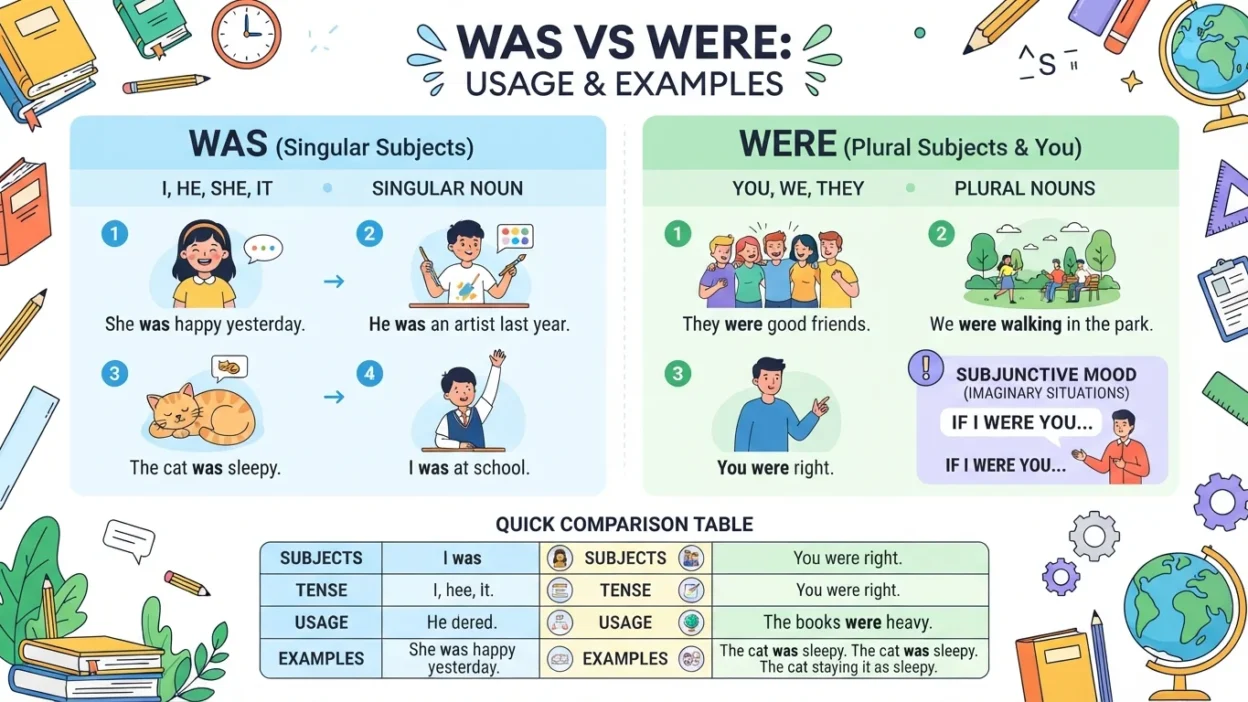
The difference between was and were depends mainly on the subject of the sentence.
- Was is used with singular subjects.
- Were is used with plural subjects and the pronoun you.
Choosing the correct form makes your writing grammatically accurate and easier to understand.
Was vs Were at a Glance
| Subject | Correct Word | Example |
|---|---|---|
| I | Was | I was tired. |
| He | Was | He was late. |
| She | Was | She was smiling. |
| It | Was | It was raining. |
| You | Were | You were right. |
| We | Were | We were ready. |
| They | Were | They were excited. |
When to Use Was
Use was with singular subjects and the pronoun I when talking about something that happened in the past.
Examples
- I was busy yesterday.
- She was at the library.
- He was my teacher.
- It was a beautiful day.
- The dog was sleeping.
Common Situations Where Was Is Correct
| Situation | Example |
|---|---|
| Past description | She was kind. |
| Past location | He was at home. |
| Past feeling | I was nervous. |
| Past weather | It was cold. |
| Singular noun | The book was interesting. |
Using was is straightforward because it matches one person, one thing, or one singular noun in the past tense.
When to Use Were
Use were with you, we, they, and all plural nouns when talking about the past. It is also used with all subjects in many hypothetical or unreal situations (the subjunctive mood), such as “If I were you.”
Examples
- You were very helpful.
- We were happy to see everyone.
- They were waiting outside.
- The students were excited about the trip.
- If I were you, I would accept the offer.
Common Situations Where Were Is Correct
| Situation | Example |
|---|---|
| Plural subject | The children were playing. |
| You | You were right. |
| We | We were ready. |
| They | They were late. |
| Unreal condition | If she were here, she would help. |
Was vs Were Comparison
| Feature | Was | Were |
|---|---|---|
| Singular subjects | ✅ Yes | ❌ No |
| Plural subjects | ❌ No | ✅ Yes |
| I | ✅ Yes | ❌ No (except subjunctive) |
| You | ❌ No | ✅ Yes |
| Subjunctive mood | Rare | ✅ Standard (“If I were…”) |
Easy Trick to Remember
A quick memory trick is:
- Was = One person or one thing (I, he, she, it).
- Were = More than one person or thing (you, we, they).
Also remember this special grammar rule:
- ✅ If I were you…
- ❌ If I was you… (acceptable in some casual speech, but “were” is the standard form in formal English.)
Common Mistakes
Many learners accidentally write:
❌ You was late.
✅ You were late.
Another common mistake is:
❌ They was happy.
✅ They were happy.
People also confuse the subjunctive:
❌ If I was rich, I would travel the world.
✅ If I were rich, I would travel the world.
Real-Life Examples
| Situation | Correct Sentence |
|---|---|
| School | The teacher was absent today. |
| Sports | The players were ready for the match. |
| Travel | We were in London last summer. |
| Weather | It was sunny all afternoon. |
| Advice | If I were you, I’d study a little more. |
From my experience, thinking about the subject first makes choosing was or were much easier than memorizing long grammar rules.
Why Do People Confuse Was and Were?
Many people mix up was and were because both are past tense forms of the verb to be. The confusion becomes even greater when sentences begin with if, since standard grammar often uses were instead of was in hypothetical situations.
Another reason is that informal speech sometimes ignores grammar rules. While you may hear phrases like “If I was you,” formal English and most style guides recommend “If I were you.”
Practice Quiz
Choose the correct answer.
- She ___ at the meeting yesterday.
- ✅ was
- They ___ very excited about the trip.
- ✅ were
- If I ___ taller, I would play basketball.
- ✅ were
- We ___ ready before the event started.
- ✅ were
- It ___ a wonderful performance.
- ✅ was
Quick Summary
| Situation | Correct Word |
|---|---|
| I | Was |
| He, she, it | Was |
| Singular noun | Was |
| You | Were |
| We, they | Were |
| Plural noun | Were |
| Hypothetical (“If I…”) | Were |
Frequently Asked Questions
Is it “I was” or “I were”?
Normally, I was is correct for past events. However, in hypothetical situations, use I were, as in “If I were you.”
Why do we say “If I were you”?
This is an example of the subjunctive mood, which describes imaginary or unreal situations. In standard English, were is the correct choice.
Can I say “you was”?
No. Standard English always uses you were, whether you are speaking to one person or many.
Is “they was” ever correct?
In standard grammar, no. The correct form is they were. Although some dialects use they was, it is considered non-standard.
How can I remember the difference?
Think of this easy rule:
- Was = I, he, she, it (singular)
- Were = you, we, they (plural and you), plus all subjects in hypothetical situations like “If I were…”
Final Thoughts
Knowing when to use was or were is an important step toward writing and speaking clear English. Use was with singular subjects in the past, were with plural subjects and you, and remember the special rule for hypothetical sentences like “If I were you.” Once you practice with real examples, the difference becomes easy to remember.

William Cooper is a U.S.-based content writer at Aslikee who focuses on creating clear, informative, and user-friendly content. He is committed to delivering information that is accurate, practical, and easy for readers to understand.
He believes that strong content comes from careful research and attention to detail. William takes time to ensure that each article meets quality standards and provides real value to users.
At Aslikee, William contributes to maintaining editorial consistency and improving content quality. His goal is to support readers with reliable information and help build long-term trust in the platform.