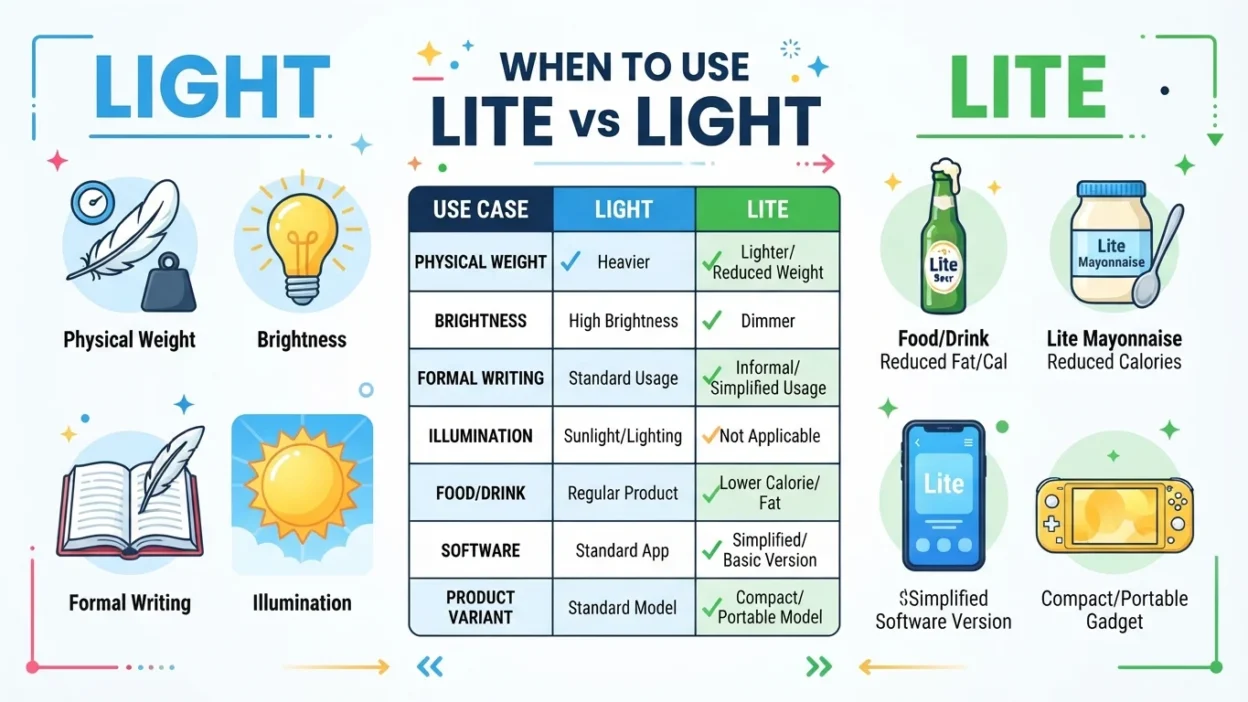
Choosing between Lite or Light becomes easy once you understand when each spelling is appropriate in everyday English and professional writing. Lite or Light helps explain the difference between light, the standard, traditional spelling, and lite, a non-standard, informal variant used mainly in marketing and branding. From my experience, remembering the purpose of each word prevents many common spelling mistakes.
Use light when referring to physical weight, brightness, illumination, something not heavy, or a lack of density. It can function as a noun, verb, adjective, or adverb, making it the correct choice for formal writing, academic writing, and everyday concepts. Unless a product officially uses lite in its name, light is usually the safest spelling to use.
Use lite only in informal contexts because it is primarily used for marketing, advertising, and branding. It often indicate products with reduced calories, reduced sugar, or less fat, including lite beer, Miller Lite, and lite mayonnaise. You’ll also find it on product labels and tech products like Nintendo Switch Lite, where it describes a simplified version, stripped-down version, or streamlined software with fewer features. Understanding this difference helps you choose the right spelling in different situations.
Quick Answer
| Word | Best Use | Example |
|---|---|---|
| Light | Standard English, formal writing, weight, brightness | light bag, light bulb |
| Lite | Branding, marketing, reduced calories, simplified products | Miller Lite, Nintendo Switch Lite |
What Is the Difference Between Lite and Light?
The main difference between lite and light is purpose.
Light is the traditional English spelling used in dictionaries and formal writing. It can describe weight, brightness, color, or something that is not heavy.
Lite is an informal spelling created mainly for marketing and branding. Companies use it to show that a product has fewer calories, less sugar, less fat, or fewer features than the regular version.
Lite vs Light Comparison
| Feature | Light | Lite |
|---|---|---|
| Standard dictionary word | ✅ Yes | ❌ No |
| Formal writing | ✅ Yes | ❌ Rarely |
| Academic writing | ✅ Yes | ❌ No |
| Product branding | Sometimes | ✅ Yes |
| Reduced-calorie products | Rarely | ✅ Yes |
| Simplified software or devices | Rarely | ✅ Yes |
What Does Light Mean?
The word light has several meanings, making it one of the most useful words in English.
It can describe something that weighs little, something bright, or even something gentle or not serious.
Common Uses of Light
| Meaning | Example |
|---|---|
| Not heavy | The bag is light. |
| Brightness | Turn on the light. |
| Pale color | Light blue paint. |
| Gentle | A light breeze. |
| Fire or ignite | Light a candle. |
Example Sentences
- The suitcase is surprisingly light.
- Please turn off the light before leaving.
- She wore a light jacket in spring.
- The room was filled with natural light.
- He used a match to light the candle.
What Does Lite Mean?
Unlike light, lite is not a traditional English spelling.
Instead, businesses use it for branding and advertising to suggest that something is reduced, simplified, or contains fewer calories or ingredients.
Common Uses of Lite
| Product Type | Example |
|---|---|
| Beer | Miller Lite |
| Soft drinks | Lite soda |
| Mayonnaise | Lite mayonnaise |
| Apps | Lite version |
| Gaming | Nintendo Switch Lite |
Because lite is closely linked with product names, you should avoid using it in formal essays, reports, or school assignments unless it is part of an official brand name.
When Should You Use Light?
Use light whenever you are writing standard English. It is the correct choice for school assignments, business emails, books, news articles, and formal communication.
It also works in many different grammatical roles, making it much more versatile than lite.
Common Situations
| Situation | Correct Example |
|---|---|
| Physical weight | This box is light. |
| Brightness | The light is very bright. |
| Color | She painted the room light gray. |
| Fire | Please light the candle. |
| Formal writing | Always use light unless referring to a brand. |
When Should You Use Lite?
Use lite only when it is part of a brand name or when a company intentionally uses it to suggest a reduced or simplified version of a product.
You will often see it in advertising rather than in everyday writing.
Common Examples
| Product | Meaning |
|---|---|
| Miller Lite | Beer with fewer calories than the regular version |
| Nintendo Switch Lite | Simplified version of the Nintendo Switch |
| Lite mayonnaise | Reduced-fat mayonnaise |
| Lite app | App with fewer features and a smaller download size |
| Lite software | Lightweight version of software |
Light vs Lite Examples
Seeing both words side by side makes the difference much clearer.
| Incorrect | Correct |
|---|---|
| This backpack is lite. | This backpack is light. |
| Please switch on the lite. | Please switch on the light. |
| I bought Miller Light. | I bought Miller Lite. |
| I installed the Lite version of the app. | ✅ Correct |
| She prefers light meals. | ✅ Correct |
Why Companies Use “Lite”
Many businesses choose lite because it sounds modern and quickly tells customers that a product has been reduced in some way.
It may mean:
- Fewer calories
- Less sugar
- Less fat
- Smaller size
- Fewer software features
- Lower storage requirements
That is why you often see lite on food packaging, mobile apps, and electronic devices.
Common Mistakes
Many English learners assume lite is simply another correct spelling of light.
It isn’t.
Outside of branding and marketing, light is almost always the correct choice.
Mistake Examples
| Incorrect | Correct |
|---|---|
| The suitcase feels lite. | The suitcase feels light. |
| The room has plenty of lite. | The room has plenty of light. |
| I need a lite jacket. | I need a light jacket. |
| I downloaded the app’s Lite version. | ✅ Correct |
Easy Memory Trick
A simple way to remember the difference is:
- Light = Real English word used in everyday writing.
- Lite = Marketing word often used by brands.
Think of famous product names like Nintendo Switch Lite or Miller Lite. If you’re not talking about an official product name or a reduced version, choose light.
From my experience, remembering this one rule prevents almost every mistake.
Frequently Asked Questions
Is it lite or light?
It depends on the context. Light is the correct standard English spelling for most situations, while lite is mainly used in product names, branding, and advertising.
Why do companies use “lite” instead of “light”?
Companies use lite to suggest that a product contains fewer calories, less fat, less sugar, or offers a simplified version with fewer features.
Is “lite” a real English word?
Yes, lite is recognized as an informal word. However, it is not considered the standard spelling and is mainly used in marketing, advertising, and official brand names.
Should I write “light” in school assignments?
Yes. In essays, reports, exams, and professional writing, light is almost always the correct choice unless you are referring to a specific brand such as Nintendo Switch Lite or Miller Lite.
Is Nintendo Switch Lite spelled correctly?
Yes. Nintendo Switch Lite is the official product name chosen by Nintendo, so Lite is correct because it is part of the brand.
Quick Practice Quiz
Choose the correct word.
- This backpack is very ______.
- ✅ light
- I downloaded the ______ version of the app.
- ✅ lite
- Please turn off the ______ before leaving.
- ✅ light
- She bought a bottle of ______ beer.
- ✅ lite
- The feather feels very ______.
- ✅ light
Key Takeaways
| Situation | Correct Word |
|---|---|
| Physical weight | Light |
| Brightness or illumination | Light |
| Formal or academic writing | Light |
| Reduced-calorie food or drinks | Lite |
| Simplified software or devices | Lite |
| Official brand names | Lite (when part of the name) |
Final Thoughts
Understanding the difference between lite and light is easier than it first appears. Use light for normal English writing, physical weight, brightness, and formal communication. Reserve lite for branding, product names, and items designed to be lighter, simpler, or reduced in calories or features. Once you know this rule, you’ll choose the correct spelling with confidence.

Robert Parker is a U.S.-based author at Aslikee who is dedicated to producing accurate and trustworthy content for readers. He focuses on presenting information in a clear and organized way, making complex topics easier to understand.
He values thorough research and careful fact-checking to ensure every piece of content meets high quality standards. Robert believes that consistency and reliability are essential for building long-term reader trust.
At Aslikee, Robert plays an important role in supporting editorial quality and content improvement. His goal is to help users access useful, well-structured information that adds real value to their experience.